
Julia Kristeva:
Julia Kristeva is a philosopher and psychoanalyst whose work explores language, identity, and the unconscious, introducing influential ideas such as abjection and the semiotic dimension of meaning.

The philosophy of logic is a branch of philosophy that focuses on the nature, foundations, and principles of logic. It seeks to understand the nature of logical truth, the structure of valid arguments, and the relationship between logic and reasoning. Key areas of inquiry within this field include:
Nature of Logic: Philosophers of logic explore what logic is and its fundamental nature. They examine whether logic is a product of human convention or a discovery of objective truths.
Logical Truth: The philosophy of logic investigates the concept of logical truth and the distinction between logical truths and contingent truths. It explores whether logical truths are necessary and universally valid.
Logical Systems: Philosophers analyze various logical systems, such as classical logic, modal logic, intuitionistic logic, and many-valued logics. They consider the strengths, limitations, and applications of different logical systems.
Validity and Soundness: This aspect of the philosophy of logic examines what makes an argument valid and the distinction between valid and sound arguments. It delves into the criteria for assessing the correctness of deductive reasoning.
Logical Paradoxes: Philosophers explore various logical paradoxes, such as the liar paradox and the Russell paradox, and their implications for our understanding of truth and the limits of formal systems.
Formal vs. Informal Logic: The field considers the distinction between formal logic, which deals with abstract symbolic systems, and informal logic, which deals with reasoning in natural language. Philosophers investigate the relationship between these two forms of logic.
Logic and Language: The philosophy of logic explores the connection between logic and language, including the role of logic in linguistic meaning, reference, and communication.
Logical Realism vs. Anti-Realism: Philosophers debate whether logical truths exist independently of human thought (logical realism) or are products of human conventions (logical anti-realism).
Philosophy of Mathematics: The philosophy of logic intersects with the philosophy of mathematics, particularly in discussions about the nature of mathematical objects, the foundations of mathematics, and the relationship between logic and mathematics.
Epistemology of Logic: Philosophers investigate how we come to know logical truths, whether through a priori reasoning, empirical investigation, or other means. They also explore the nature of logical intuitions and their role in logical discovery.
The philosophy of logic plays a foundational role in philosophy, mathematics, computer science, and many other disciplines. It helps us understand the principles of valid reasoning, the structure of arguments, and the nature of logical systems, contributing to our broader understanding of knowledge, truth, and rationality.
Julia Kristeva is a philosopher and psychoanalyst whose work explores language, identity, and the unconscious, introducing influential ideas such as abjection and the semiotic dimension of meaning.
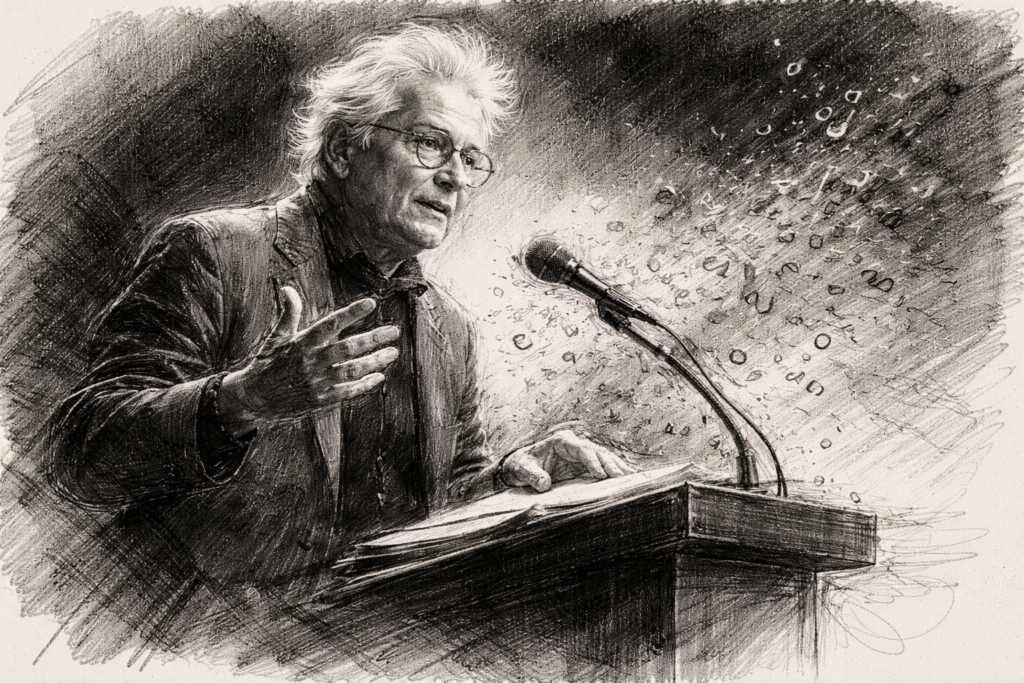
Jacques Derrida was a French philosopher best known for developing deconstruction, a way of reading texts that exposes hidden assumptions, hierarchies, and instabilities in language. His work reshaped philosophy, literature, law, and cultural theory by showing that meaning is never fixed, but always in motion.

Dewi Zephaniah Phillips was a Welsh philosopher whose work focused on religion, ethics, and the nature of meaning. Rejecting both dogmatic faith and militant scepticism, he argued that religious practices must be understood through the lived realities of human life rather than as claims that require scientific defence.

Elizabeth Anscombe, one of the most influential analytic philosophers of the twentieth century, transformed modern ethics and action theory through her work on intention, virtue, and moral reasoning. Drawing on Aristotle and Aquinas while engaging the legacy of Wittgenstein, she challenged the foundations of modern moral philosophy and helped revive virtue ethics as a central philosophical approach.

Discover the life and legacy of Alan Turing — codebreaker, mathematician, and pioneer of AI. From the Enigma machine to the Turing Test, explore how his genius shaped modern computing.

Discover Jerry Fodor’s revolutionary ideas on the mind and thought processes, blending philosophy and science to unravel human cognition.

Discover Carl Gustav Hempel’s innovative philosophy, particularly his Paradox of the Ravens, which challenges scientific methodology and prompts reflection on the nature of evidence.

Explore Charles Sanders Peirce’s revolutionary ideas on pragmatism and semiotics. Delve into his intricate web of knowledge to understand the practical implications of signs in our changing world.

Explore the world of Thomas Bayes, a statistician whose work in Bayesian probability continues to shape predictions. Discover how his concepts revolutionized fields like statistics and machine learning.

Study philosophy to understand rational thinking and decision making. Learn how it helps navigate human cognition and behavior.