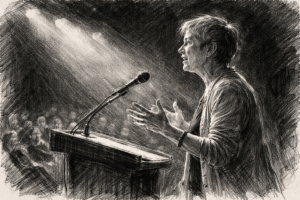
Elizabeth Anscombe (1919–2001) stands as one of the most influential philosophers of the twentieth century, shaping modern discussions of ethics, action theory, and the philosophy of mind. Born in Limerick and educated at Oxford, she became a central figure in analytic philosophy, while simultaneously drawing inspiration from the classical tradition of Aristotle and the theological insights of Thomas Aquinas. Her deep Catholic conviction was not merely a personal detail; it sat at the centre of her philosophical worldview and often placed her at odds with prevailing intellectual fashions.
Her career included fellowships at Oxford and Cambridge, close study under Ludwig Wittgenstein, and ultimately a professorship at the University of Cambridge. She famously served as one of Wittgenstein’s literary executors, contributing to the editing and translation of his later works. Politically and morally courageous, she once campaigned against Oxford awarding an honorary degree to U.S. President Harry Truman over the atomic bombings of Hiroshima and Nagasaki. It was an early demonstration of a theme that would define her life: moral language matters, moral truth matters, and philosophy has a duty to speak plainly about both.
Intention and Human Action
Anscombe’s most celebrated book, Intention (1957), reshaped the philosophy of action. Before her intervention, many philosophers treated intentional behaviour almost as a mechanistic pairing of beliefs and desires. Anscombe insisted that understanding intention required paying close attention to how agents describe their own actions.
A simple example illustrates this. Imagine someone raising their arm. That movement might be described as:
- waving to a friend
- stretching
- turning on a light
- or merely contracting certain muscles
All are technically accurate descriptions, yet only some capture what the person is doing intentionally. Her point is that intention is not discovered purely in physical motion but in the meaningful descriptions under which the agent understands and endorses the action.
This shift gave philosophy a far richer way to think about agency, responsibility, and human motivation. In her analysis, intentional action is tied to reasons, purposes, and the agent’s own perspective — not just external observation.
Another notable contribution is her explanation of the difference between beliefs and desires. Beliefs aim to fit the world; desires attempt to make the world fit them. This “direction-of-fit” idea is now a staple in contemporary philosophy.
Ethics and the Challenge to Modern Moral Theory
Anscombe’s essay Modern Moral Philosophy (1958) is often said to have reignited interest in virtue ethics. She argued that both utilitarian and Kantian approaches had drifted into abstraction, losing sight of essential questions about character, virtue, and human flourishing.
Her critique had three central ideas:
-
Modern ethical theories use moral language — “duty,” “obligation,” “ought” — without the older religious or metaphysical frameworks that once gave these terms meaning.
-
A return to Aristotelian virtue ethics offers a more grounded account of moral life, where good action flows from cultivated character rather than rule-following or outcome-calculating alone.
-
Moral psychology — how humans actually think, choose, and intend — must be central to ethics, not an afterthought.
She also coined the term consequentialism, now standard for theories that judge actions solely by their outcomes. Anscombe found such views inadequate because they risked excusing morally questionable acts if the results appeared favourable.
Her moral philosophy was not ivory-tower speculation. It fuelled strong public stances on issues like war, euthanasia, and the ethics of intention versus foresight — debates that continue to resonate.
Language, Mind, and the First-Person Perspective
Anscombe also contributed to the philosophy of language and mind, especially in her treatment of the first-person pronoun “I.” She questioned the traditional assumption that “I” refers to a private mental object or inner entity. Instead, she explored how self-reference functions as a unique form of expression that resists simple reduction to naming.
Her ideas here influenced debates on personal identity, self-knowledge, and consciousness — themes still vital in contemporary analytic philosophy and cognitive science.
Legacy and Continued Influence
Anscombe leaves behind a philosophical legacy both rigorous and unfashionably fearless. Her revival of intentionality and virtue ethics continues to shape contemporary debates in philosophy, ethics, law, theology, psychology, and even artificial intelligence, where questions about agency, intention, and moral reasoning matter more than ever.
She showed that philosophy can be both logically exacting and morally serious. To treat ethics as mere abstraction is, in her view, to misunderstand its very purpose. We act in the world; therefore, philosophy must care about what action means and what sort of people we ought to become.
Reading List
Essential Works by Anscombe
-
Intention (1957)
Her groundbreaking analysis of intentional action and the nature of human agency. Still required reading in philosophy departments worldwide. -
Collected Philosophical Papers (3 Volumes)
Volume I: From Parmenides to Wittgenstein,
Volume II: Metaphysics and the Philosophy of Mind,
Volume III: Ethics, Religion and Politics
A comprehensive way to engage with her thought across subjects. -
“Modern Moral Philosophy” (1958)
The essay that reshaped twentieth-century ethics and reintroduced virtue into the analytic tradition.
Secondary and Contextual Works
-
Michael Thompson – Life and Action
Develops themes rooted in Anscombe’s work on action and practical reasoning, and clarifies her legacy. -
Roger Teichmann – The Philosophy of Elizabeth Anscombe
A clear, structured guide through her major ideas and philosophical method. -
Cora Diamond – Reading Wittgenstein with Anscombe
Illuminates her connection to Wittgenstein and shows how she extended his work. -
Philippa Foot – Virtues and Vices
A close friend and collaborator whose revival of virtue ethics complements Anscombe’s project. -
Alasdair MacIntyre – After Virtue
Not by Anscombe, but deeply influenced by her — a modern cornerstone for understanding virtue ethics.
Introductory / Accessible Guides
-
Iain Hampsher-Monk – A History of Modern Political Thought (sections on Anscombe and virtue ethics)
-
1000-Word Philosophy: “Elizabeth Anscombe”
A concise online introduction ideal for first-time readers. -
BBC Radio 4 – In Our Time: Elizabeth Anscombe
Accessible discussion with philosophers unpacking her work and influence.
Further Information
(Online resources — open in a new tab)