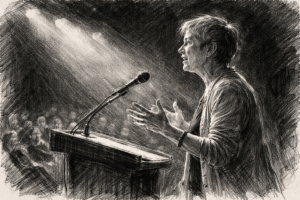
Alan Turing was not just a mathematician. He was a mind that lived ahead of its time — a visionary whose ideas bridged logic, philosophy, and the earliest foundations of modern computing. In the 20th century, Turing stood at the intersection of two great human pursuits: understanding the nature of thought and creating machines that could replicate aspects of it.
The Early Mind
Born in London in 1912, Turing’s fascination with patterns, puzzles, and problem-solving emerged early. School reports hinted at his brilliance — and at a stubborn refusal to learn in the “accepted” way. This independence of thought would define his life and work. By the time he reached King’s College, Cambridge, his talent for pure mathematics had already set him apart.
Inventing the Theoretical Computer
In 1936, at just 24, Turing published On Computable Numbers. Within this dense and beautiful piece of logic lay the idea of the “Turing Machine” — a simple, imaginary device that could simulate any conceivable computation if given the right instructions. In essence, he defined the blueprint for what we now call the programmable computer.
Philosophically, this was profound. Turing wasn’t just solving an abstract mathematical problem — he was probing the very nature of processes, algorithms, and whether “thinking” could be reduced to rules. He helped plant the seed for one of the most enduring questions in technology: If the brain follows rules, could a machine think like a human?
The War Years and Bletchley Park – Cracking the Code That Changed History

When the Second World War erupted, Nazi Germany’s military communications were protected by the Enigma machine — an electro-mechanical encryption device capable of producing over 150 quintillion possible message configurations. This constant reconfiguration, changed daily, made the code effectively unbreakable by human effort alone.
Enigma’s scrambled messages coordinated U-boat wolf packs in the Atlantic, directed troop movements across occupied Europe, and transmitted high-level orders from Hitler’s headquarters. Without breaking it, the Allies were fighting in the dark.
At Bletchley Park, Britain’s top-secret codebreaking centre, Alan Turing led a team tasked with defeating Enigma. Building on groundwork laid by Polish cryptographers, Turing designed the Bombe — an electro-mechanical marvel that could run through thousands of possible Enigma settings in hours rather than months. It turned an impossible problem into a daily routine.
The results, codenamed Ultra, gave the Allies an invisible advantage. Convoys could be steered away from U-boat ambushes. Air raids could strike key targets before the Germans moved. Field commanders could plan operations knowing the enemy’s intentions in advance.
Historians estimate that the work at Bletchley, with Turing’s contributions at its heart, shortened the war by at least two years and saved millions of lives. Winston Churchill described the codebreakers as “the geese that laid the golden eggs — and never cackled.”
Philosophical Lens: This wartime collaboration was a precursor to the way we work with AI today. Humans brought strategic insight; machines brought relentless computational power. Together, they achieved what neither could do alone.
The Turing Test
After the war, Turing turned his mind to the future. In his 1950 paper Computing Machinery and Intelligence, he proposed what became known as the Turing Test — a thought experiment in which a machine could be said to “think” if a human interlocutor could not tell whether they were conversing with a person or a computer.
This wasn’t just a technical benchmark. It was a philosophical gauntlet. Turing reframed the ancient “What is thought?” debate into a testable, modern challenge. It still frames AI discussions today, though in our age, the test feels closer than ever to being passed.
The Tragedy
Despite his monumental contributions, Turing was persecuted for being gay at a time when homosexuality was illegal in the UK. In 1952, he was convicted of “gross indecency” and forced to undergo chemical castration. Just two years later, at 41, he died — officially by suicide, though some historians still question the circumstances.
His death was a loss not only to science but to humanity’s moral standing. It is a reminder that progress in one field can be undermined by prejudice in another.
The Legacy
Today, Turing’s name lives on — in computer science, in philosophy of mind, in cryptography, and even in biology (he also worked on mathematical models of morphogenesis — the way patterns form in nature). His story has inspired books, films, and public apologies. In 2013, the British government issued a posthumous pardon; in 2021, he became the face of the £50 note.
Philosophically, Turing challenges us to hold two ideas at once:
-
That the boundaries of thought and intelligence are not fixed.
-
That technological progress is meaningless if society does not progress with it.
Turing and the Road Ahead
In an age when AI is no longer theoretical, Turing’s work feels less like history and more like prophecy. His Turing Machine was an idea; now we carry millions of them in our pockets. His Turing Test was a thought experiment; now we hold conversations with machines daily.
The question is no longer whether machines can think, but how we will live alongside them — and whether we will make better choices than the world made with Turing himself.
Suggested Reading & Resources:
- Alan Turing: The Enigma by Andrew Hodges
- Computing Machinery and Intelligence (1950) — Alan Turing’s original paper
- Bletchley Park Museum: bletchleypark.org.uk
- Turing Archive for the History of Computing: The Turing Digital Archive
- Wikipedia: Alan Turing
See Also:
Image Attribution
See page for author, Public domain, via Wikimedia Commons