Modern Philosophy 20th CE

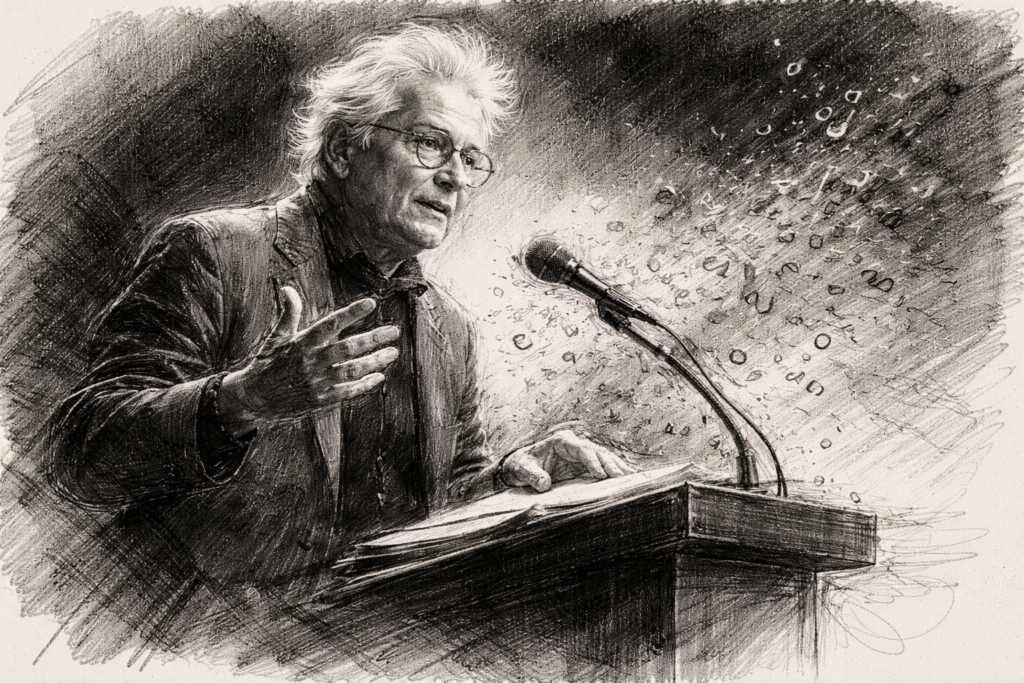
Derrida's lecture in fragmented words

Jacques Derrida: Meaning on the Move

Jacques Derrida was a French philosopher best known for developing deconstruction, a way of reading texts that exposes hidden assumptions, hierarchies, and instabilities in language. His work reshaped philosophy, literature, law, and cultural theory by showing that meaning is never fixed, but always in motion.

Dewi Zephaniah Phillips Portrait

Dewi Zephaniah Phillips: When Meaning Is Found in the Way We Live, Not in What We Prove

Dewi Zephaniah Phillips was a Welsh philosopher whose work focused on religion, ethics, and the nature of meaning. Rejecting both dogmatic faith and militant scepticism, he argued that religious practices must be understood through the lived realities of human life rather than as claims that require scientific defence.

Michel Foucault, French philosopher

Michel Foucault: Power, Knowledge, and the Invisible Forces That Shape Us

Michel Foucault was one of the most influential thinkers of the twentieth century, exploring how power, knowledge, and social institutions shape human behaviour. His ideas challenge traditional views of authority, truth, and identity, revealing the invisible systems that govern everyday life.

Philippa Foot Virtue, Reason and the Moral Life

Philippa Foot: Virtue, Reason and the Moral Life

Philippa Foot was a leading twentieth-century philosopher who revived virtue ethics and challenged prevailing views about moral judgement. Best known for the trolley problem and her theory of “natural goodness,” she argued that virtues are grounded in human nature and essential to human flourishing. Her work continues to shape contemporary debates in ethics, character, and moral psychology.

Mary Midgley: Understanding Human Nature Beyond Reductionism

Mary Midgley was a pioneering British philosopher who challenged reductionism, defended the importance of ethical and ecological understanding, and argued that human life requires multiple forms of explanation beyond science alone. Her work on animals, moral imagination and intellectual humility remains deeply relevant today.

Elizabeth Anscombe: Intention, Virtue, and the Revival of Moral Philosophy

Elizabeth Anscombe: Intention, Virtue, and the Revival of Moral Philosophy

Elizabeth Anscombe, one of the most influential analytic philosophers of the twentieth century, transformed modern ethics and action theory through her work on intention, virtue, and moral reasoning. Drawing on Aristotle and Aquinas while engaging the legacy of Wittgenstein, she challenged the foundations of modern moral philosophy and helped revive virtue ethics as a central philosophical approach.

Simone Weil: A Life of Attention, Affliction, and Radical Moral Seriousness

Simone Weil was a French philosopher, mystic, and social activist whose life embodied radical intellectual and moral commitment. Known for her powerful reflections on suffering, attention, labour, and the need for spiritual humility, she remains one of the most compelling and challenging thinkers of the twentieth century. This article explores Weil’s life, key ideas, and enduring influence.

María Zambrano: The Poet-Philosopher Who Reimagined Reason

María Zambrano: The Poet-Philosopher Who Reimagined Reason

María Zambrano was a Spanish philosopher whose poetic approach to reason reshaped modern thought. Exploring exile, democracy, the inner self, and the divine, she blended philosophy and literature to reveal deeper ways of understanding human experience.

Henri Bergson: The Philosopher of Time and Intuition

Life and Background Henri Bergson (1859–1941) was a French philosopher whose ideas transformed how we think about time, consciousness, and creativity. Born in Paris to a Polish-Jewish father and an English-Irish mother, Bergson displayed brilliance early on, excelling in both the sciences and the humanities. He studied at the prestigious École Normale Supérieure, where he …

Henri Bergson: The Philosopher of Time and Intuition Read More »

Max Horkheimer: Architect of Critical Theory

Max Horkheimer: Architect of Critical Theory

Max Horkheimer’s name is synonymous with the heart of the Frankfurt School. As one of its towering figures, Horkheimer not only led the Institute for Social Research through its most formative years but also helped shape what we now know as Critical Theory—a framework that blends philosophy, sociology, and culture to dissect the complexities of modern society.