
Julia Kristeva:
Julia Kristeva is a philosopher and psychoanalyst whose work explores language, identity, and the unconscious, introducing influential ideas such as abjection and the semiotic dimension of meaning.

The philosophy of language is a branch of philosophy that explores the nature, structure, and function of language, as well as the relationship between language, thought, and the world. It addresses fundamental questions about the meaning of words, the nature of linguistic communication, and the role of language in shaping our understanding of reality. Here are key aspects of the philosophy of language:
1. Language and Meaning:
– Semantics: Semantics is the study of meaning in language. Philosophers of language examine how words, phrases, and sentences acquire meaning and how they represent or refer to objects, concepts, or states of affairs in the world.
– Truth and Reference: Philosophers explore questions related to truth conditions and reference, considering how language accurately reflects or corresponds to the world.
2. Language and Thought:
– Language and Thought: Philosophers investigate the relationship between language and thought, including whether language is a necessary medium for thought and how language influences our cognitive processes and conceptual categories.
– Mental Representations: The study of mental representations examines how concepts and meanings are represented in the mind and how language relates to these mental structures.
3. Language and Communication:
– Speech Acts: Philosophers of language study speech acts, which involve the illocutionary force (e.g., making a promise, asking a question) of an utterance and the perlocutionary effect (e.g., persuading, informing) on the listener.
– Pragmatics: Pragmatics explores how context, speaker intentions, and social factors influence the interpretation of language. It includes the study of implicature, presupposition, and conversational maxims.
4. Reference and Meaning:
– Theories of Reference: Philosophers propose theories of reference, such as direct reference theory, descriptivism, and causal theories, to explain how words refer to objects or entities in the world.
– Sense and Reference: The distinction between sense (the way a word is understood) and reference (the object it denotes) is a central theme in the philosophy of language. This distinction is associated with the work of Gottlob Frege.
5. Language and Reality:
– Ontological Commitments: Philosophers consider the ontological commitments of language, which refer to the kinds of entities or properties that are implied or presupposed by linguistic expressions. Questions of existence and reality are explored in this context.
6. Meaning and Translation:
– Translation and Indeterminacy: The study of translation highlights the challenges of accurately translating language from one language to another and raises questions about the indeterminacy of meaning.
7. Language and Identity:
– Language and Identity: Language is closely tied to individual and cultural identities. Philosophers explore how language shapes personal identity, social identity, and group identity.
8. Analytic and Continental Philosophy:
– Different philosophical traditions, such as analytic and continental philosophy, approach the philosophy of language differently. Analytic philosophy tends to focus on formal and logical aspects of language, while continental philosophy often explores the existential, hermeneutic, and phenomenological dimensions of language.
9. Philosophy of Linguistics:
– The philosophy of linguistics addresses foundational issues in linguistics, such as the nature of linguistic competence, the structure of language, and the relationship between language and cognition.
10. Language and Ethics:
– Philosophers may examine ethical dimensions of language, including issues related to language and power, hate speech, freedom of speech, and the ethics of linguistic representation.
The philosophy of language is a diverse and evolving field with a long history, spanning from ancient Greek philosophy to contemporary debates about language and meaning. It has important implications for a wide range of philosophical areas, including epistemology, metaphysics, ethics, and the philosophy of mind.
Julia Kristeva is a philosopher and psychoanalyst whose work explores language, identity, and the unconscious, introducing influential ideas such as abjection and the semiotic dimension of meaning.
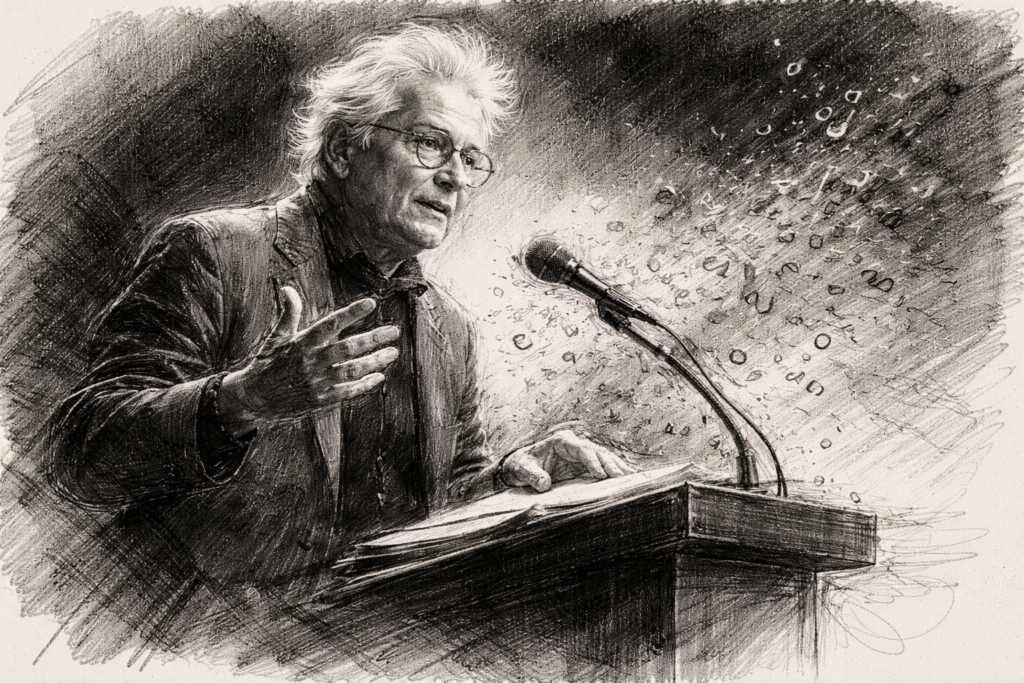
Jacques Derrida was a French philosopher best known for developing deconstruction, a way of reading texts that exposes hidden assumptions, hierarchies, and instabilities in language. His work reshaped philosophy, literature, law, and cultural theory by showing that meaning is never fixed, but always in motion.

Dewi Zephaniah Phillips was a Welsh philosopher whose work focused on religion, ethics, and the nature of meaning. Rejecting both dogmatic faith and militant scepticism, he argued that religious practices must be understood through the lived realities of human life rather than as claims that require scientific defence.

Elizabeth Anscombe, one of the most influential analytic philosophers of the twentieth century, transformed modern ethics and action theory through her work on intention, virtue, and moral reasoning. Drawing on Aristotle and Aquinas while engaging the legacy of Wittgenstein, she challenged the foundations of modern moral philosophy and helped revive virtue ethics as a central philosophical approach.

Life and Background Henri Bergson (1859–1941) was a French philosopher whose ideas transformed how we think about time, consciousness, and creativity. Born in Paris to a Polish-Jewish father and an English-Irish mother, Bergson displayed brilliance early on, excelling in both the sciences and the humanities. He studied at the prestigious École Normale Supérieure, where he …
Henri Bergson: The Philosopher of Time and Intuition Read More »

Language has always been humanity’s most powerful tool—a bridge connecting people, a marker of identity, and, at times, a weapon for division. From the biblical myth of Babel to the rise of global empires, and now into the age of artificial intelligence, the evolution of communication tells a story of ambition, diversity, and resilience. I …
Rebuilding Babel: Language, AI, and the Future of Communication Read More »

Explore David Chalmers’ ideas on consciousness and naturalistic dualism, emphasizing subjective experience in understanding reality.

Discover Jerry Fodor’s revolutionary ideas on the mind and thought processes, blending philosophy and science to unravel human cognition.

Explore John Searle’s innovative ideas challenging AI limits and delving into consciousness. Discover his works on intentionality, social reality, and philosophy of mind.

Follow Hilary Putnam’s journey from math to influential philosopher in mind, language, and science. Learn about his pragmatic and interdisciplinary approach to unraveling human mysteries.