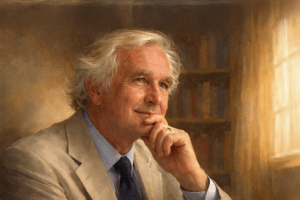
This morning I read a fascinating article in Popular Mechanics with extracts from an interview with Michael Levin. He’s a biologist by training, but let’s not box him in. He thinks like a philosopher, speaks like a systems theorist, and experiments like a sci-fi writer who’s convinced the future is already happening under a microscope. Based at Tufts University, Levin is probably best known for his work in developmental biology, regeneration, and bioelectricity. He suggests that cells are more floating sacks of biological material that perform a systematic function; they’re chatting away in tiny electrical murmurs, the sum of which contribute to intelligence of the entire organism. Levin has built a career not just listening in on these conversations, but nudging them to say something new.
The interview in Popular Mechanics, “Conscious ‘Alien Minds’ Could Be Living Among Us—And We Don’t Even Know It, Scientist Says”, starts off talking about tadpoles and ends with you questioning the nature of your own consciousness. He’s not just asking, “How do organisms develop?” but pushing right into the metaphysical bunker: “What is intelligence? What’s a mind? And just how weird do things have to get before we stop calling it science and start calling it magic?”
Let’s see if we can make sense of some of it without our brains short-circuiting.
 What is Intelligence, According to Levin?
For Levin, intelligence isn’t some precious substance locked inside skulls. It’s not the exclusive domain of humans, or even animals with proper nervous systems. He suggests intelligence is a spectrum, a sliding scale, a process that can emerge anywhere there’s a system solving problems across space and time.
At one end of the intelligence spectrum we consider basic cellular function. For example, how do white blood cells detects a wound and moves to clear infection? Or, when a plant turns toward the light, solving the spatial problem of energy intake, is that just a mechanical function or is it a form of intelligence. Not as a metaphor. Literally. This challenges our deepest assumptions. Because if intelligence is problem-solving over time, then all sorts of things we think of as dumb are actually, in their own way, smart.
The human brain naturally features towards the other end of the spectrum. Levin argues that the brain may not be solely responsible for intelligence and the body isn’t merely a vehicle and support system for the brain. Levin uses the example of the planarian flatworm. Chop it up, and each piece regrows the entire worm. Even its memories persist, despite the “brain” having been removed and rebuilt. This perspective makes you wonder where the self actually lives.
He’s hinting that the mind may be distributed. Consciousness might be spread across the entire body. And if that’s true, we need to question if the human brain is indeed the seat of the soul alone.
The Soul, the Self, and Slippery Boundaries
In the Popular Mechanics article, Levin makes a curious comment about the soul. Now, he’s not going all woo-woo here, he’s quite clear he wants to naturalise the concept, not mystify it. But it’s still striking. My interpretation is that he is suggesting the soul might simply be a kind of pattern continuity. A memory of past goals. An ability to pursue future ones. A system that holds together across disruptions.
Which, fine. But here’s where I get twitchy: where does that leave character? Where’s personality in all this? If intelligence is just behaviour emerging from system dynamics, and the systems themselves can be rearranged, then what makes you you? If your cells can be reprogrammed, your memories restored in new tissue, and your goals redirected, do you remain the same person?
This nudges us toward the idea that maybe identity is more fluid and ever-shifting, held together by process rather than substance. And if that’s true, if we’re just stable-ish patterns held in place by habit and feedback loops, then who or what is actually doing the thinking?
Are we not, then, just temporary arrangements of intention and response? Is ‘Steff’ (me) just a name I give to this current configuration of experience?
Are We All Connected?
Here’s where it gets really strange, but it aligns. with my own emerging conclusions… Levin doesn’t quite say we’re all one, but he opens a door to that possibility and gestures at it like, “Make of that what you will.” If intelligence is a distributed process, and cells communicate across space using bioelectrical fields, then maybe the boundary between humans isn’t as firm as we’d like to think.
Afterall, we are merely a collection of cells. Levin talks about the relationships between branches of science, religion and mysticism, and how their theories fall into the rough regarding the fairway of intelligence. I see his views, wholistic as they are, still has an angle, a fuzzy angle but an angle nonetheless.
I like and refer to the research about gut flora and how it influences us. Go down the rabbit hole, if you want, regarding the concept of alien microorganisms colonising the human gut, potentially impacting health, or the idea that gut bacteria, often referred to as “alien” in a metaphorical sense (you decide), play a crucial role in our health and even our behaviour.
There’s something faintly “Avatar”, or “the force” in Star Wars about Levin’s views. Certainly in the deep structural implication: the idea that mind might be entangled across organisms, across space. The cells in your heart might not be conscious, but they might be participating in something that is. It calls to mind Spinoza’s idea of a single substance, God or Nature, thinking through finite modes like us. Or Schopenhauer’s ‘Will’, a universal striving that manifests in all things. Or the Buddhist idea that the self is not a fixed entity, but a convenient fiction.
In this respect Levin’s vision echoes my own instinct. Where he arrives through experimental insight and bioelectric logic, I’ve reached similar terrain through a more syncretic route… a kind of informed intuition shaped by religious thought, mystical traditions, philosophical frameworks, and a healthy appetite for speculative ideas, including those usually shelved under science fiction. Rather than a single doctrine, my view is a synthesis; a belief that meaning and mind might emerge from a tapestry of perspectives, not a solitary path.
What if Levin’s research is quietly confirming what mystics have been muttering for millennia? That consciousness is not a possession, but a relationship. That minds aren’t bottled up in skulls, they’re braided into the fabric of existence.
And this has real implications. For how we design artificial intelligences. For how we treat animals (look up Jeremy Bentham). For how we consider moral worth. If clumps of cells can behave with intelligence, do they deserve rights? What about a swarm of robots? What about an eco-system? Are we drawing the boundary of personhood too tightly?
Patterns, Scales, and the Illusion of Hierarchy
Here’s the kicker: we humans, just like we want to see faces in patterns and patterns in chaos, love our hierarchies. We want intelligence to come with a scoreboard, chimps above dogs, dolphins somewhere near toddlers, and humans naturally at the top, polishing our Nobel Prizes so not to be potentially outshone by AI. But maybe this whole framework is wrong.
Maybe intelligence isn’t a pyramid but a network. Not a straight line, but a constellation. (I love the image that compares neural networks with connections seen throughout deep space.) Levin’s work hints at this. Intelligence might be radial, localised, or emergent. It might show up in slime moulds, forests, or self-organising systems of synthetic cells. It could be a glowing gaseous cloud capable of faster than light intergalactic travel.
We love to find patterns, our brains hardwired to seek them. But maybe the real story is that everything is a pattern. Not in a “we live in a simulation” kind of way (although who knows?), but in the sense that form, behaviour, and intention are all emergent from the same soup of causality. A cloud, as random as it appears, strictly follows current laws of physics. Could personality, that standard we use to value ourselves as individuals, be only slightly more complicated than a cloud (on a universal scale).
And maybe, and this is where it gets properly cosmic, intelligence isn’t even a biological property. Maybe it’s something woven into the fabric of energetic interactions themselves. Maybe the universe thinks, not in words, not in thoughts, but in structure. In flows. In the way matter arranges itself to solve problems.
In which case, we’re all just sparks in the dark. Brief flickers of awareness trying to make sense of ourselves before we scatter back into the field.
It’s a bit much for a Saturday morning, I admit. But this is the kind of thinking Levin provokes. It’s not tidy. It’s not comfortable. But it’s alive. And I suspect we’ve only just scratched the surface.
So what are your thoughts..? I’d love to hear from you. Comment here or wherever you are reading or listening to this.
Discover more:
Read the article: “Conscious ‘Alien Minds’ Could Be Living Among Us—And We Don’t Even Know It, Scientist Says”
Image attributes:
John Templeton Foundation, CC BY 3.0, via Wikimedia Commons