
 Ernst Mach (1838–1916) was an Austrian physicist and philosopher who bridged the worlds of science and human experience. Best known for his pioneering studies on sound, motion, and visual perception, Mach’s work profoundly influenced both the development of modern physics and the philosophy of science. His insistence that all knowledge must ultimately be grounded in sensory experience helped shape the thinking of generations of scientists — including Albert Einstein, who later credited Mach’s ideas as a key inspiration for his theory of relativity.
Life a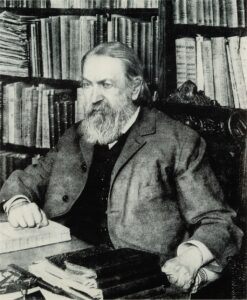 nd Work
Born in Moravia (now part of the Czech Republic), Mach studied physics and mathematics at the University of Vienna. His early experiments focused on the physics of sound and shock waves, leading to the term “Mach number” — the ratio of an object’s speed to the speed of sound — still used today to describe supersonic travel.
Mach’s curiosity, however, extended far beyond mechanics. He was fascinated by how humans perceive the world, arguing that science should not assume an objective reality independent of observation. To him, sensations were not mere reflections of the external world but the raw data from which all understanding arises. This view placed him firmly in the camp of empirio-criticism — a philosophy suggesting that scientific concepts are summaries of sensory experiences, not descriptions of things-in-themselves.
In his famous experiments on visual perception, Mach demonstrated how the mind constructs reality. The Mach bands illusion, where the eye perceives exaggerated contrasts between shades, revealed that perception is an active process, shaped as much by the brain as by the external world. These insights would later influence early psychologists and philosophers who explored how consciousness filters experience.
Mach was also deeply skeptical of metaphysics — particularly the notion of absolute space and time. He rejected Isaac Newton’s idea of a fixed background against which motion occurs, instead insisting that motion could only be defined relative to other bodies. This seemingly abstract argument laid the philosophical groundwork for Einstein’s relativity, which replaced Newton’s absolutes with relational principles.
Beyond science, Mach was a professor of physics in Prague and later a professor of philosophy in Vienna. Despite suffering a stroke in 1898 that left him partially paralysed, he continued to write influential works, including The Analysis of Sensations (1886), where he explored the interplay between mind, matter, and meaning.
Relevance Today
Mach’s insistence that perception and experience form the foundation of science continues to resonate in fields ranging from cognitive neuroscience to quantum physics. His critique of absolutes anticipated modern debates about observer effects and measurement in quantum mechanics. In psychology, his insights foreshadowed ideas about the brain’s predictive nature — the understanding that perception is an act of interpretation, not passive reception.
Mach’s philosophy reminds us that knowledge is never detached from the observer. Every theory, however elegant, is rooted in the way we experience and interpret the world. In an age of artificial intelligence and virtual reality, his message feels more relevant than ever: our understanding of “reality” is as much a creation of perception as it is a discovery of truth.
![Ernst Mach's historic 1887 photograph (shadowgraph) of a bow shockwave around a supersonic bullet[11]fired from a Werndl carbine.](https://philosophical.chat/wp-content/uploads/2025/10/512px-Photography_of_bow_shock_waves_around_a_brass_bullet_1888-300x300.jpg) Pilots and aerospace engineers still use the Mach number every day as a fundamental measure of speed relative to sound. When an aircraft’s velocity equals the speed of sound, it is said to be travelling at Mach 1. Speeds beyond that—Mach 2, Mach 3, and so on—are described as supersonic or hypersonic, depending on how many times the speed of sound they exceed. The value changes with altitude and temperature, since sound travels faster in warmer, denser air. This means a pilot’s indicated Mach number is a crucial reference for performance limits, fuel efficiency, and safety—especially when approaching the transonic range, where shock waves begin to form on the wings and fuselage.
Pilots and aerospace engineers still use the Mach number every day as a fundamental measure of speed relative to sound. When an aircraft’s velocity equals the speed of sound, it is said to be travelling at Mach 1. Speeds beyond that—Mach 2, Mach 3, and so on—are described as supersonic or hypersonic, depending on how many times the speed of sound they exceed. The value changes with altitude and temperature, since sound travels faster in warmer, denser air. This means a pilot’s indicated Mach number is a crucial reference for performance limits, fuel efficiency, and safety—especially when approaching the transonic range, where shock waves begin to form on the wings and fuselage.
Reading List
- The Analysis of Sensations – Ernst Mach
- Knowledge and Error: Sketches on the Psychology of Enquiry – Ernst Mach
- The Science of Mechanics – Ernst Mach
- Philosophy of Science: A Very Short Introduction – Samir Okasha
- Einstein: His Life and Universe – Walter Isaacson
Further Reading
Image attribution
Charles Scolik, Public domain, via Wikimedia Commons
Ernst Mach (1838–1916), Public domain, via Wikimedia Commons


.jpg)
