
Julia Kristeva:
Julia Kristeva is a philosopher and psychoanalyst whose work explores language, identity, and the unconscious, introducing influential ideas such as abjection and the semiotic dimension of meaning.

Embark on a fascinating journey through history, exploring the minds of famous philosophers who have profoundly influenced our world. From the ancient wisdom of Socrates, Plato, and Aristotle, who laid the foundations of Western philosophy, to the Eastern insights of Confucius and Laozi, we witness a tapestry of thought. The Middle Ages introduced St. Augustine and Thomas Aquinas, blending theology with philosophy. The Enlightenment era brought forth thinkers like Kant and Rousseau, revolutionising ethics and political theory. Modern philosophy saw Nietzsche and Wittgenstein challenging traditional notions, while contemporary figures like Chomsky continue to inspire intellectual discourse.
Julia Kristeva is a philosopher and psychoanalyst whose work explores language, identity, and the unconscious, introducing influential ideas such as abjection and the semiotic dimension of meaning.

Patricia Churchland is a pioneering neurophilosopher whose work connects philosophy of mind, neuroscience, and morality, arguing that understanding the brain is essential to understanding ourselves.

Angela Davis is a philosopher and activist whose work explores race, feminism, capitalism, and prison abolition, arguing for collective liberation and a radical rethinking of justice.

Nancy Fraser is a leading political philosopher whose work explores social justice through the lenses of redistribution, recognition, and democratic participation, offering a powerful critique of capitalism, feminism, and identity politics in the modern world.
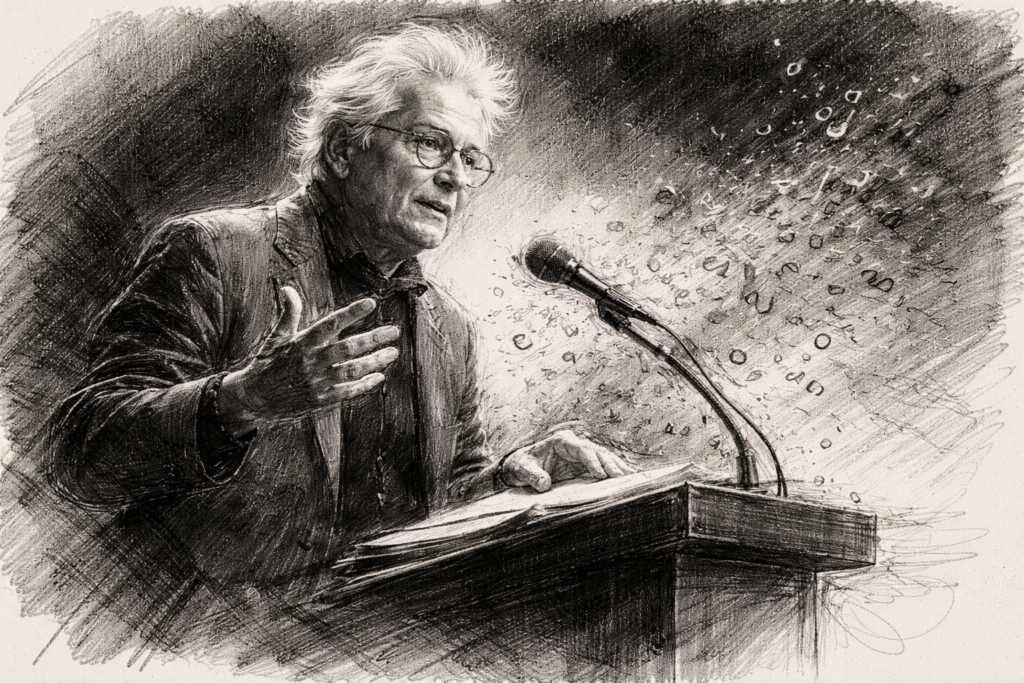
Jacques Derrida was a French philosopher best known for developing deconstruction, a way of reading texts that exposes hidden assumptions, hierarchies, and instabilities in language. His work reshaped philosophy, literature, law, and cultural theory by showing that meaning is never fixed, but always in motion.

Luce Irigaray is a Belgian-born philosopher and feminist theorist whose work examines how language, culture, and philosophy construct gender. Her writing challenges the idea that the masculine is the default form of human experience, arguing instead for a world where difference between genders is recognised without hierarchy.

Dewi Zephaniah Phillips was a Welsh philosopher whose work focused on religion, ethics, and the nature of meaning. Rejecting both dogmatic faith and militant scepticism, he argued that religious practices must be understood through the lived realities of human life rather than as claims that require scientific defence.

Cressida J. Heyes argues that identity is shaped through social forces, personal discipline, and systems of power. Her work on the self, gender, and transformation challenges the idea of identity as something inner and fixed, and instead explores how we are continually trained to become ourselves.

Philippa Foot was a leading twentieth-century philosopher who revived virtue ethics and challenged prevailing views about moral judgement. Best known for the trolley problem and her theory of “natural goodness,” she argued that virtues are grounded in human nature and essential to human flourishing. Her work continues to shape contemporary debates in ethics, character, and moral psychology.

Mary Midgley was a pioneering British philosopher who challenged reductionism, defended the importance of ethical and ecological understanding, and argued that human life requires multiple forms of explanation beyond science alone. Her work on animals, moral imagination and intellectual humility remains deeply relevant today.