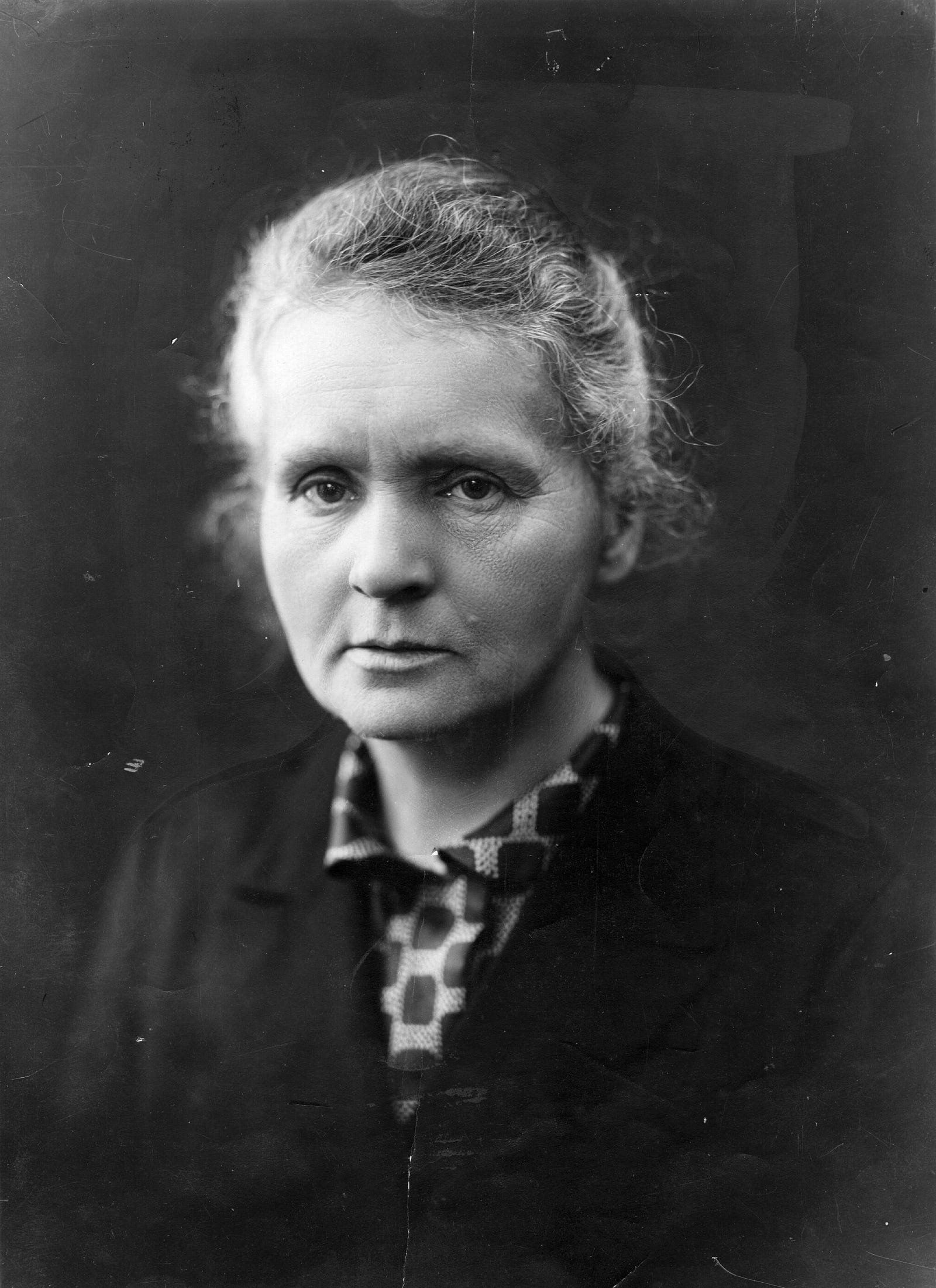
Early Life and Education
Marie Skłodowska Curie was born in Warsaw, Poland, in 1867 — a time when women were largely excluded from higher education. The youngest of five children, she grew up in a household that valued learning, despite living under the repressive rule of the Russian Empire. Her father, a teacher of mathematics and physics, encouraged her curiosity early on, sparking a lifelong fascination with the natural world.
Denied access to Polish universities, Curie studied at the clandestine “Flying University,” a secret institution that educated young Poles — particularly women — who were otherwise barred from formal academia. In 1891, she moved to Paris to study at the Sorbonne, earning degrees in physics and mathematics with remarkable distinction. It was in Paris that she met Pierre Curie, a fellow scientist who would become her husband and closest collaborator.
Discoveries and Breakthroughs
 Together, the Curies embarked on groundbreaking research into the mysterious phenomenon Henri Becquerel had recently discovered — radioactivity, a term Marie herself coined. Through meticulous experimentation, they isolated two new elements: polonium (named after her beloved Poland) and radium, both far more radioactive than uranium.
Their discoveries redefined our understanding of matter. The atom, once thought indivisible, was revealed as a complex structure capable of transformation and decay. In 1903, Marie and Pierre Curie shared the Nobel Prize in Physics with Becquerel. After Pierre’s tragic death in 1906, Marie continued their research alone, becoming the first woman to teach at the Sorbonne and, in 1911, the first person ever to win a second Nobel Prize — this time in Chemistry — for her work on radium and polonium.
Curie’s Ideas and Philosophy of Science
Marie Curie’s work was not only scientific but philosophical in nature. Her dedication embodied the ideal of science as a moral pursuit: a quest for knowledge pursued with integrity, sacrifice, and devotion to truth.
She believed that scientific progress was a means to elevate humanity, yet she also recognised its double-edged nature. Radium, once a symbol of progress, would later become associated with danger, disease, and atomic warfare. Still, Curie never lost faith in the human capacity to use knowledge responsibly. Her life reflected a profound belief in perseverance, humility, and intellectual equality — especially between men and women.
 Later Life and Legacy
During the First World War, Curie developed mobile X-ray units, known as “Little Curies,” to assist battlefield surgeons — a practical application of her research that saved countless lives. Despite suffering long-term radiation exposure, she continued to work tirelessly, founding the Radium Institute in Paris, which became a global centre for nuclear physics and medical research.
Marie Curie’s legacy extends far beyond her scientific achievements. She shattered barriers for women in science, proving through quiet determination that intellect has no gender. Her notebooks remain so radioactive that they are still stored in lead boxes, a haunting reminder of how far she pushed the boundaries of human understanding.
Influence and Cultural Impact
Curie’s influence rippled across both science and society. She inspired generations of women — from Lise Meitner and Rosalind Franklin to contemporary physicists and chemists — to pursue research at the highest levels.
Culturally, she became an icon of intellect, modesty, and endurance. Her story continues to shape discussions about gender equality in academia, ethical responsibility in science, and the human cost of discovery. Even today, the word Curie is synonymous with brilliance and devotion.
Reading List
-
Madame Curie by Ève Curie
-
Obsessive Genius: The Inner World of Marie Curie by Barbara Goldsmith
-
Radioactive: Marie & Pierre Curie — A Tale of Love and Fallout by Lauren Redniss
-
Marie Curie and the Science of Radioactivity by Naomi Pasachoff
Further Reading
- Wikipedia – Marie Curie
- Stanford Encyclopedia of Philosophy – Marie Skłodowska-Curie
- Nobel Prize Official Biography – Marie Curie
- Encyclopaedia Britannica – Marie Curie
Image Attribution
Smithsonian Institution from United States, No restrictions, via Wikimedia Commons
By Henri Manuel – cdn-images-1.medium.com, Public Domain, Link


_and_Marie_Sklodowska_Curie_(1867-1934),_c._1903_(4405627519).jpg)