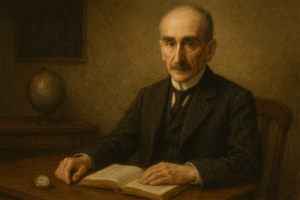
Few writers have shaped our collective imagination as profoundly as Isaac Asimov. To call him “prolific” almost feels rude in its understatement. The man wrote or edited around 500 books, spanning science fiction, chemistry, popular science, children’s encyclopaedias, and even Shakespeare guides. He didn’t simply explore ideas; he seemed to unwrap the entire universe, flatten it delicately onto his desk, and type until it all made sense.
What made Asimov stand out wasn’t just his output, but the clarity and optimism at the heart of his worldview. Where many writers of the Cold War era leaned towards dystopia, Asimov’s imagination remained defiantly constructive. His stories acknowledged danger, but insisted on human potential. That combination, caution mixed with faith in reason, is what gives Asimov his lasting relevance.
 From Brooklyn Classrooms to Galactic Empires
Asimov’s early life is the classic immigrant tale. Born in 1920 in Russia, he arrived in the United States at the age of three. His family ran sweet shops in Brooklyn, and it was there, between the scent of candy and dusty stacks of pulp magazines, that he discovered science fiction. He devoured everything. Then he began to write his own stories. And eventually, John W. Campbell of Astounding Science Fiction became his mentor, a relationship that remains famous, messy and creatively explosive.
By his mid-20s, Asimov had already created the seeds of his two great fictional universes: the Robot stories and the Foundation series. The former gave us the iconic Three Laws of Robotics, which still influence debates about AI ethics today. The latter imagined a far-future galactic civilisation governed by “psychohistory,” a mathematical model predicting human behaviour on vast scales. As ideas go, it’s pure intellectual catnip.
The Philosophical Core: A Rationalist to the Bone
Asimov wasn’t just a storyteller; he was a public philosopher in disguise. His writing radiates a belief that problems, even frightening ones, become less terrifying when examined clearly. He trusted in scientific literacy, rational thinking, and the ethical use of technology.
His essays are particularly delightful in this regard. He could explain nuclear physics to a ten-year-old without condescension, or unpack the quirks of human fallibility with a grin. Asimov understood something essential: people fear what they don’t understand, and knowledge, shared generously, is a form of empathy.
This worldview makes him a bridge between the Enlightenment and the digital age. Asimov believed that humans, given the right tools and information, can improve… something we badly need reminding of in an age of cynicism.
Robots, Rules, and Real-World Consequences
The Three Laws are often cited as Asimov’s crowning invention, but interestingly, he never intended them as a literal engineering blueprint. They were a narrative device, a way to turn robots from mindless threats into thinking partners. They offer a moral framework, not a user manual.
Yet their philosophical weight is astounding. These laws force us to ask:
What does it mean to harm? To obey? To act in someone’s best interest?
And crucially:
Should a machine be bound by moral rules we struggle to follow ourselves?
Modern AI researchers still refer to these laws, not because they’re practical, but because they illuminate something fundamental about human–machine relationships. Asimov understood the psychological challenge of creating intelligence that rivals our own. He asked the right questions long before we built the tools.
A Universe of Ideas: Foundation and the Shape of History
The Foundation series is Asimov’s masterpiece. At its core lies a tantalising concept: what if we could predict the future of entire societies with scientific accuracy? Psychohistory is part sociology, part mathematics, part philosophy, a fictional discipline with a real-world echo. It mirrors our urge to understand the messy patterns of civilisation.
Asimov’s vision of history is sweeping but never bleak. Empires rise and collapse, but knowledge, if preserved, becomes humanity’s lifeline. It’s a theme that quietly echoes the idea that the long arc of human curiosity matters.
The Man Behind the Words
Asimov’s personality was as distinctive as his prose: witty, smug in an almost lovable way, endlessly curious, and allergic to romanticising the past. He liked facts. He liked order. He liked to find the best in people.
His writing style is deceptively simple. Sentences flow with the ease of someone who thought at the speed of typing. He avoided metaphors he considered pointless, and he hated ambiguity. Yet in his fiction, he explored some of the most profound uncertainties imaginable — identity, morality, destiny, and the fragility of civilisation.
Legacy: Still Speaking to the Future
Asimov’s influence is everywhere: in robotics, in AI ethics debates, in the architecture of shared fictional universes, in the confidence that science can make life better. He helped shape the blueprint of modern speculative thought.
But perhaps his greatest legacy is not technological at all. It’s emotional. Asimov wrote with a kind of intellectual kindness — a belief that human beings can rise to their challenges. Even now, as we hurtle towards an age of artificial intelligence and climate anxiety, his voice encourages us to stay rational, stay curious, and stay hopeful.
Because if Asimov taught us anything, it’s that the future isn’t written — but it can be guided.
Suggested Reading
-
This list is not exhaustive. There are hundreds of further titles (children’s books, textbooks, co-authored works, edited anthologies) that I have omitted for clarity.
-
Some books tie into multiple series/universes (e.g., Asimov later unified his robot and Foundation worlds) so reading order can vary.
-
Publication order vs internal chronological order: there are debates among fans which matters more.
-
The non-fiction works list is just a sample — Asimov ventured into many popular-science topics, history, essays, poetry, and more.
Isaac Asimov bibliography (categorical)
Isaac Asimov bibliography (chronological)
Core Fiction Series & Stand-alone Highlights
-
Robots / Robot series
-
I, Robot (1950) — short story collection introducing the Three Laws of Robotics.
-
The Caves of Steel (1954) — first full-length Robot novel.
-
The Naked Sun (1957) — follow-up.
-
The Robots of Dawn (1983) — later novel, deeper themes.
-
Robots and Empire (1985) — melds Robot series with wider universe.
-
-
Galactic Empire / Foundation Universe
-
The Stars, Like Dust (1951) — early Empire novel.
-
The Currents of Space (1952) — same setting.
-
Foundation (1951) — the original “Foundation” trilogy begins.
-
Foundation and Empire (1952) — second book.
-
Second Foundation (1953) — third in original set.
-
Foundation’s Edge (1982) — later continuation.
-
-
Major Short-Story Collections & Stand-Alones
-
The Bicentennial Man and Other Stories (1976).
-
Nightfall and Other Stories (1969) — including the famous “Nightfall”.
-
-
Non-Fiction & Popular Science (select)
-
The Intelligent Man’s Guide to Science (1960) — later updated editions.
-
Asimov’s Guide to Shakespeare (1970) — dives into literature rather than science.
-
Asimov’s Biographical Encyclopedia of Science and Technology (1964) — spectacular reference work.
-
Suggested Reading Order
Phase 1: Robots – Start with “I, Robot” then the Robot novels; these introduce his core themes of ethics, technology, and humanity.
Phase 2: Foundation/Empire – Move into his grand civilisational sweep with the Foundation sequence and the empire set.
Phase 3: Short Collections & Stand-Alones – For variety and deeper philosophical angles.
Phase 4: Non-fiction – To explore the “real world” Asimov: the scientist, thinker and educator.
Further Exploration
Image Attribution
Rochester Institute of Technology, Public domain, via Wikimedia Commons
See also: