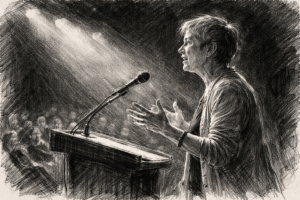
Aldous Huxley occupies a curious and commanding position in modern intellectual history. Though best known for Brave New World, to see him only as a dystopian novelist sells him short. Huxley investigated the human condition from almost every angle: the seductions of power, the dangers of comfort, the nature of consciousness, and the stubborn desire humanity has for transcendence. In many respects, he did not simply describe the future — he anticipated the society we now inhabit, one defined less by oppression than by distraction, less by tyranny than by the quiet tyranny of ease.
Early Life and Intellectual Formation

Born in 1894 into a family where science and culture intertwined, Huxley’s early world was filled with debate, inquiry, and high expectations. His grandfather, Thomas Henry Huxley, was a renowned biologist and a fierce defender of Darwinian thought. The young Aldous, however, faced a dramatic change in direction when an illness left him nearly blind in adolescence. Unable to pursue a scientific career as originally intended, he turned instead to literature and philosophy. This loss, rather than narrowing him, broadened him. He became a thinker with scientific literacy, literary sensitivity, and a deep hunger to understand the workings of the human mind and society. His move to the United States in the 1930s further expanded his intellectual horizons, immersing him in a culture of experimentation and early countercultural thought.
Brave New World and the Politics of Comfort
When Huxley published Brave New World in 1932, he created a vision of the future that felt disturbingly plausible — not because it was cruel, but because it was seductive. He imagined a society built on genetic engineering, psychological conditioning, casual consumerism, and engineered bliss. Rather than being forced into conformity by violence or fear, the citizens of his imagined world willingly surrendered autonomy for convenience and pleasure. Truth became irrelevant in the face of endless distraction and entertainment; questioning authority seemed unnecessary when everything felt comfortable enough. In contrast to George Orwell’s later 1984, where power is maintained through terror, Huxley warned that the most effective form of control is the one people gladly accept. In a world of glowing screens, dopamine metrics, and algorithmic comfort, Huxley’s vision now feels uncomfortably prophetic.
Beyond Dystopia: Mysticism, Consciousness, and Human Potential
It would be a mistake, though, to treat Huxley as purely a critic of modernity. His later work turns inward, seeking not only to diagnose society’s failings but also to explore humanity’s potential for growth and transcendence. Through texts like The Doors of Perception and The Perennial Philosophy, he wrestled with the limits of ordinary awareness and the possibility that human consciousness is only a fragment of a much wider reality. He suggested that the mind usually functions as a “reducing valve,” filtering experience down to what is necessary for survival rather than what is ultimately true. Mystical practices, spiritual discipline, and even psychedelics, in his view, could reveal deeper layers of perception and meaning. His interest in a universal, experiential spirituality — something shared across cultures and traditions — helped shape later conversations about mindfulness, altered states, and inner transformation.
Huxley’s Ethical and Political Philosophy
Across his essays, novels, and lectures, Huxley consistently returned to themes of freedom, autonomy, and human dignity. He viewed centralised power, unchecked technology, and mass persuasion as existential threats — not because they would overtly crush the human spirit, but because they could coax it into complacency. He favoured decentralised communities, education that cultivates awareness rather than obedience, and spiritual practice as a counterweight to materialism. At heart, Huxley believed that genuine freedom was not merely political but deeply personal; it required clarity of mind, self-knowledge, and the courage to resist the subtle forces that dull independent thought. His critique of modernity was balanced by a conviction that growth was possible — that humanity could rise, not only through innovation, but through insight.
Legacy and Contemporary Relevance
Huxley left behind a body of work that continues to shape debates about technology, freedom, and the future of human consciousness. Today, his warnings about pleasure-driven conformity and technological pacification resonate strongly in a world wrestling with digital dependency and manufactured distraction. Yet he was not simply a prophet of danger; he was equally a student of potential, convinced that human beings could evolve inwardly as well as outwardly. If Orwell feared a world where truth was suppressed by force, Huxley feared one where truth faded quietly beneath comfort. Our cultural moment often seems closer to his vision than his contemporaries realised.
In Huxley’s universe, the real battle is not just for political liberty, but for the integrity of the human spirit. That remains a timely challenge.
Suggested Reading
Primary Works
-
Brave New World (1932)
-
Brave New World Revisited (1958)
-
The Perennial Philosophy (1945)
-
The Doors of Perception (1954)
-
Island (1962) — his utopian counterpoint to Brave New World
Further Exploration
Image Attribution
Aldous Huxley, Public domain, via Wikimedia Commons