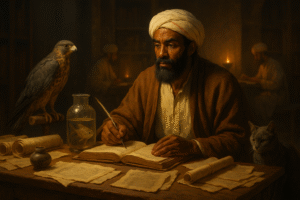
Zhuangzi (also written Chuang-tzu) was one of the most brilliant and imaginative thinkers of the Warring States period. Alongside Laozi, he shaped Daoism into a philosophy that offered an alternative to the rigid morality of Confucians and the harsh laws of Legalists. While Laozi’s Dao De Jing is brief, poetic, and enigmatic, Zhuangzi’s own text is expansive, witty, and filled with playful paradoxes.
Zhuangzi did not write as a system-builder, but as a storyteller. His parables, dialogues, and jokes are deliberately slippery: just when you think you’ve grasped his meaning, he turns the idea upside down. This wasn’t carelessness, but part of his method. By shaking us out of fixed ways of thinking, he wanted to free us to live more naturally, more spontaneously, and more in tune with the Dao — the Way of things.
Key Ideas
1. Relativity of Perspectives
For Zhuangzi, truth is not absolute. What is big to one creature is tiny to another; what is useful in one situation is useless in another. He tells of the enormous bird Peng, which soars for thousands of miles, contrasted with the small cicada and dove who mock it, unable to imagine such vastness. Both perspectives are valid — but partial.
This leads to one of his central insights: human distinctions (right/wrong, noble/base, useful/useless) are not universal truths but relative judgments. If we cling to them, we become trapped. By recognising their relativity, we gain freedom.
2. The Dream of the Butterfly
His most famous passage blurs the line between dream and waking life:
“Once Zhuang Zhou dreamed he was a butterfly, a butterfly flitting about happily. He did not know he was Zhou. Suddenly he woke, and there he was, Zhou. But he did not know whether he was Zhou who had dreamed of being a butterfly, or a butterfly dreaming he was Zhou.”
This isn’t just a whimsical thought. It questions identity itself. If self and world are in constant transformation, how stable is the “I” we cling to? Zhuangzi invites us to see identity as fluid — to embrace change rather than resist it.
3. Freedom Through Spontaneity (Wu Wei)
 Like Laozi, Zhuangzi valued wu wei (non-forcing or effortless action). But he illustrated it with vivid, everyday stories.
The most famous is the Butcher Ding parable: Ding carves an ox without effort, his knife gliding through the natural spaces between bones. He never hacks or forces; he follows the animal’s own structure. His blade stays sharp for years because he moves with the Dao.
The lesson is clear: true skill, and true living, come not from rigid control but from flowing with natural patterns. Whether cooking, governing, or simply walking through life, forcing things creates resistance and wear. Going with the grain brings ease and harmony.
4. The “Useless” Has Its Use
Zhuangzi delighted in overturning conventional values. Where others saw usefulness as good, he found wisdom in the useless. He tells of a gnarled, twisted tree that carpenters reject as worthless — yet precisely because it cannot be cut down, it grows tall and free.
The message is paradoxical: what society despises as “useless” may in fact guarantee survival. By refusing to play the game of productivity, fame, and ambition, one can live long and live well. This is both satire of Confucian achievement culture and an invitation to rethink what really matters.
5. Equality of Life and Death
Unlike Confucians, who stressed filial piety and ritual mourning, Zhuangzi viewed life and death as natural transformations, equally part of the Dao.
When his wife died, his friend Hui Shi found him drumming on a pot and singing. Shocked, Hui Shi asked why he wasn’t grieving. Zhuangzi replied that at first he mourned, but then he realised she had simply returned to the great process of transformation: from formless to form, and now back again. To resist this was to fight the Dao.
This perspective treats death not as an end, but as a shift in the eternal cycle. To accept it brings liberation from fear.
6. Language, Knowledge, and Skepticism
Zhuangzi was deeply suspicious of language and fixed knowledge. Words carve up the world into categories that oversimplify reality. He mocked philosophers who argued endlessly over “right” and “wrong,” likening them to a frog at the bottom of a well who thinks his little patch of sky is the whole world.
Instead of clinging to certainty, he recommended a kind of playful skepticism — recognising the limits of our perspective and embracing humility. Paradoxically, this recognition itself is a form of wisdom.
7. The Ideal Sage
For Zhuangzi, the sage is not a ruler, lawgiver, or moral exemplar, but someone who flows freely with the Dao. Such a person is at ease with change, does not impose rigid standards, and lives lightly. The sage laughs at ambition, adapts like water, and refuses to be trapped by convention.
The ultimate freedom, then, is freedom from clinging — to opinions, identities, goals, or even life itself.
Parallels in Western Philosophy
Zhuangzi’s thought might seem uniquely Chinese, yet it resonates strikingly with themes explored in Western philosophy.
-
Skepticism and Relativism
Zhuangzi’s insistence that truth depends on perspective recalls the Greek Sophists, who argued that what is true or just varies by culture or circumstance. Like Protagoras’ claim that “man is the measure of all things,” Zhuangzi suggested that our categories of right and wrong are relative, not absolute. His playful skepticism also foreshadows Pyrrhonian skepticism, which advised suspending judgment to achieve peace of mind. -
Dream and Reality
The butterfly dream echoes questions raised by Plato’s Allegory of the Cave — are we perceiving reality itself, or only shadows of it? Later, Descartes would doubt the certainty of waking experience in his “dream argument.” Zhuangzi’s version is less about proving certainty and more about joyfully accepting uncertainty. -
Language and Limits of Knowledge
Zhuangzi’s suspicion of words mirrors Wittgenstein’s claim that language traps us in limited “language games.” Both saw that categories distort reality, and both invited a lighter, humbler attitude towards the limits of human reason. -
Life, Death, and Transformation
His acceptance of death as natural transformation resembles Stoic philosophy, which counselled aligning oneself with nature and not fearing what is beyond one’s control. Zhuangzi, though, is less austere than the Stoics — his vision is more playful, almost comic, in facing mortality. -
Later Parallels: Montaigne and Nietzsche
The Renaissance essayist Montaigne, who loved paradox and self-questioning, seems a spiritual cousin to Zhuangzi, using humour to unsettle human pretensions. Nietzsche, too, with his laughter, perspectivism, and celebration of life’s flux, echoes the Daoist sage’s vision that we must dance with transformation rather than resist it.
Legacy
Zhuangzi’s influence stretches far beyond the Daoist tradition. His writings became a cornerstone of Chinese thought, shaping how later generations approached philosophy, art, and even daily living.
-
Daoism and Later Chinese Thought
Within Daoism, Zhuangzi provided the imaginative counterpart to Laozi’s austere mysticism. If the Dao De Jing whispers enigmas, the Zhuangzi sings, jokes, and dances with them. His emphasis on spontaneity and naturalness became central to Daoist practice, especially in meditative arts, calligraphy, and martial disciplines. -
Buddhism and Chan (Zen)
When Buddhism arrived in China, Zhuangzi’s thought created fertile ground for its assimilation. Chan (Zen) Buddhism in particular adopted his use of paradox, humour, and sudden insight to break through rigid conceptual thinking. Zen koans — those puzzling riddles designed to jolt the mind — can be seen as heirs to Zhuangzi’s butterfly dreams and useless trees. -
Literature and Poetry
Chinese poets through the Tang and Song dynasties drew heavily on Zhuangzi’s imagery of wandering sages, carefree transformations, and communion with nature. His playful style legitimised a literary tradition where humour, paradox, and lyricism could carry philosophical weight. -
Art and Aesthetics
Zhuangzi’s celebration of spontaneity influenced Chinese painting and aesthetics. The brushstroke that flows naturally, without overworking, was seen as embodying the same effortless grace as Butcher Ding’s knife. “Freehand” landscape painting owes much to his philosophy of letting the Dao express itself through the artist. -
Modern Echoes
In the modern world, Zhuangzi’s ideas resonate far beyond China. Philosophers of language and postmodern thinkers have compared him to Wittgenstein, Derrida, and Foucault. His playful relativism also influenced modern literature and science fiction — from Borges’ dreamscapes to Philip K. Dick’s questions of what is real. In a world grappling with virtual realities and AI, Zhuangzi’s butterfly dream feels oddly contemporary. -
Everyday Wisdom
Beyond academia, Zhuangzi offers a kind of spiritual lightness: not to cling too tightly, not to take ourselves too seriously, and to find freedom in laughter. His vision remains radically fresh — an antidote to the anxieties of ambition, control, and rigid certainty.
Further Reading
-
Primary Texts:
Zhuangzi (trans. Burton Watson, 1968)
The Complete Works of Zhuangzi (trans. Brook Ziporyn, 2020)
Wandering on the Way (Victor Mair, 1994) -
Secondary Sources:
Graham, A.C., Disputers of the Tao (1989)
Kjellberg, Paul & Ivanhoe, Philip J., Essays on Skepticism, Relativism, and Ethics in the Zhuangzi (1996) -
Online:
Wikipedia: Zhuang Zhou
Stanford Encyclopedia of Philosophy: Zhuangzi
Internet Encyclopedia of Philosophy: Zhuangzi
See also on Philosophical Chat:
Image attribution
Hua Zili (華祖立), Public domain, via Wikimedia Commons