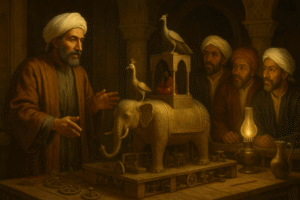
When we think of change, motion or becoming we often assume these are the most obvious features of reality. But for Parmenides of Elea, what we see moving, turning and transforming may just be a surface show. He asks us to look beneath the flux and ask: What really is? In this post, we trace his life, his radical ideas on being and non-being, and explore how his thinking still speaks to us today.
1. Life & Context
 Parmenides was born around 515 BCE in the Greek colony of Elea (in southern Italy), and founded what became known as the Eleatic school of philosophy. Encyclopedia Britannica+1
His surviving work is a single poetic composition often referred to as On Nature, written in archaic hexameter verse, of which only fragments remain. Wikipedia+1
His method was unusual: mythic imagery (chariots, goddesses) meets rigorous argument about what it means to be. The poetic style gives it that dramatic flourish which you can lean into for your blog and YouTube visuals.
2. The Two Paths: Truth vs. Opinion
One of Parmenides’ central moves is to divide the world of inquiry into two “paths”:
-
The Way of Truth (ἀλήθεια, aletheia): This path relies on reason and concerns what truly is. Wikipedia+1
-
The Way of Opinion (δόξα, doxa): This path corresponds to our everyday sense-experience, appearances, change, multiplicity. According to Parmenides, this realm is deceptive or less reliable. Wikipedia+1
He presents this in his poem via the voice of a goddess guiding the seeker:
“I will tell thee the only two ways of search that can be thought of: the one, namely, that It is and that it is impossible for it not to be; the other, that It is not, and that it is necessary that it not be…” (Fragment B 2, trans.) Lexundria+1
This scene is full of mythic detail, which gives you excellent fodder for podcast visuals or narrational flair.
3. What “Being” Must Be
Parmenides then moves to argue what “what is” must be like. Key features:
-
It cannot come into being (because that would imply it came from what is not) and cannot perish (because it would become what is not). ontology.co+1
-
It is one, continuous, undivided — there’s no room for parts or empty space, because that would imply non-being or division. ontology.co
-
It is unchanging, immobile, eternal. Movement or change would imply a transition into or out of being—impossible under his logic. Encyclopedia Britannica+1
In short: Parmenides argues that ultimate reality (Being) is uniform, stable, and timeless; all the change we sense belongs to the world of opinion.
4. Sensory Experience, Change & Appearance
Because Parmenides elevates reason (logos) over sensation (pathos), he claims that what we perceive through our senses — motion, change, multiplicity — belongs to the realm of doxa, not aletheia.
He warns that relying on the senses alone will lead us into error. Encyclopedia Britannica+1
For you, Steff, this is a great bridge into your geography and a metaphoric way: imagine landscapes constantly changing, but beneath that, bedrock that remains. The mismatch between appearance and deep reality is very Parmenidean.
5. Why This Still Matters
-
Parmenides helped found ontology — the study of being — because he asked “what does it mean for something to be?” instead of only “what is it made of?”. Encyclopedia Britannica
-
His radical denial of change echoes in modern debates about time, identity, and physics (e.g., if time is real, or if change is fundamental).
-
For content creators: he offers a provocative angle — “What if the world we take for granted as changing is only appearance? What lies beneath?” That feeds nicely into philosophy meets everyday life meets science.
Possible Objections & Nuances
-
Yes, Parmenides’ view is extreme and many subsequent philosophers (e.g., Heraclitus) counter that change is real. You can treat this as part of the narrative tension. University at Albany
-
His “unchanging Being” is not a flat statement denying all change in our experience; rather it’s a metaphysical claim about what ultimately is. Don’t oversimplify.
-
For teaching, one can ask: even if ultimate reality is static, how do we explain dynamic phenomena we observe? That opens a rich classroom or podcast discussion.
Further Reading & References
-
Fragments of Parmenides (English translation) – accessible via online sources. mason.gmu.edu
-
“Parmenides” in Encyclopaedia Britannica. Encyclopedia Britannica
-
“The Fragments of Parmenides: The Arguments for Substance Monism” – Medium article. Medium
-
Stanford Encyclopedia of Philosophy (entry on Parmenides) for deeper scholarship.