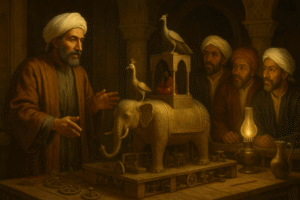
Few figures in history have captured both the mind and the heart quite like Omar Khayyam — the Persian mathematician, astronomer, philosopher, and poet whose life and legacy straddle the worlds of logic and longing. Born in Nishapur, in northeastern Iran, around 1048 CE, Khayyam lived during the Seljuk Empire, an era of great political power but also immense intellectual achievement.
In the East, he was known for his contributions to mathematics, astronomy, and philosophy. In the West, he became immortal through The Rubáiyát, a collection of quatrains that contemplate fate, mortality, and the fleeting joys of existence. Yet both identities — the scientist and the poet — belong to the same man. Khayyam’s philosophy was not confined to equations or verses; it was an attempt to reconcile the rational precision of science with the emotional truth of experience.
He understood, perhaps more than anyone, that life’s greatest paradox lies in its brevity — and that to understand the universe is to understand one’s place within it.
 Philosophical Outlook and Key Works
Omar Khayyam’s intellect flourished in the company of polymaths and scholars who gathered in Isfahan, the scientific heart of the Islamic world under the patronage of Nizam al-Mulk and the Seljuk sultans. His worldview combined Aristotelian logic, Neoplatonic metaphysics, and the analytical precision of mathematics.
His major philosophical work, Risālah fī al-Wujūd (“Treatise on Existence”), explored questions of being, causality, and the relationship between God and creation. Khayyam’s approach was neither strictly religious nor entirely secular — he sought harmony between reason and revelation, arguing that both could lead to truth if pursued sincerely.
But it was through his work as a mathematician and astronomer that his philosophical brilliance shone most clearly. His Treatise on Demonstration of Problems of Algebra (1070 CE) extended the ideas of al-Khwarizmi, classifying and solving cubic equations through geometric methods. Centuries before Descartes, Khayyam was already blending algebra and geometry — a conceptual leap that would shape modern mathematics.
He also contributed to the Jalali calendar, a solar system so precise that its margin of error is smaller than the modern Gregorian calendar. For Khayyam, measuring time was not merely scientific; it was existential — an act of understanding the rhythm of the cosmos.
Main Ideas and Contributions
1. The Unity of Science and Philosophy
Khayyam saw mathematics as a language of truth, a bridge between the physical and the metaphysical. In his writings, he described numbers and geometry as reflections of divine order — tools for glimpsing the structure of creation. Yet he also recognised the limits of reason. Mathematics could measure time, but not meaning. Science could describe motion, but not purpose.
His philosophy, therefore, was not reductionist but integrative. He believed that rational inquiry and spiritual reflection were complementary, not contradictory. This duality defined both his scientific achievements and his poetry.
2. The Rubáiyát and the Search for Meaning
Though scholars debate whether Khayyam wrote all the quatrains attributed to him, the Rubáiyát captures a distinctly Khayyamic worldview — one of scepticism, wonder, and bittersweet wisdom. The verses question dogma, mock blind piety, and celebrate the fleeting pleasures of life:
“A book of verses underneath the bough,
A jug of wine, a loaf of bread—and thou
Beside me singing in the wilderness—
Oh, wilderness were paradise enow.”
To Khayyam, the universe was vast, time was fleeting, and certainty was an illusion. Yet rather than despair, he found joy in the moment — the ecstasy of existence amid the inevitability of death. His poetry is not nihilistic but deeply human: a plea to live fully, love honestly, and think freely.
3. Doubt as a Path to Understanding
In both his philosophy and his verse, Khayyam embraced doubt as a virtue, not a flaw. He questioned everything — from religious authority to metaphysical assumptions — believing that the pursuit of truth required scepticism. His approach prefigured the rational humanism of the Enlightenment.
Yet his doubt was not cynicism. It was curiosity tinged with humility, a recognition that the human mind can seek but never fully grasp the infinite. In this sense, he was as much a philosopher of wonder as of reason.
Influence and Legacy
In his lifetime, Khayyam’s reputation as a mathematician and astronomer far outweighed his fame as a poet. Scholars across the Islamic world respected his clarity of reasoning and his advancements in geometry. His algebraic methods influenced later thinkers such as Nasir al-Din al-Tusi and, indirectly, the Renaissance mathematicians of Europe.
But centuries later, his literary afterlife transformed him into something greater. When Edward FitzGerald translated The Rubáiyát into English in 1859, Khayyam became an icon of philosophical poetry — a voice of existential reflection and secular grace in the Victorian age. His verses resonated with modern readers facing their own uncertainties about faith, science, and meaning.
In both East and West, Khayyam stands as a symbol of intellectual freedom — a thinker who refused to divide knowledge into sacred and profane, and who saw joy as a form of wisdom.
Relevance and Influence Today
In our modern world, where science and spirituality are too often set in opposition, Khayyam’s philosophy feels refreshingly whole. He reminds us that curiosity and pleasure, logic and emotion, can coexist — that the pursuit of knowledge need not exclude the appreciation of beauty.
His life bridges the gap between the analytical and the emotional, showing that truth is as much about perspective as proof. His Rubáiyát speaks powerfully to the modern condition: the tension between our quest for certainty and our need for meaning.
In an age defined by data and distraction, Khayyam whispers a simple truth: that to live wisely is to live consciously. Whether through the lens of science or the rhythm of verse, his message remains timeless — that the universe is both mystery and melody, and we, for our brief moment in it, are meant to marvel.
Further Reading
- Omar Khayyam, The Rubáiyát (translated by Edward FitzGerald)
- Omar Khayyam, Treatise on Demonstration of Problems of Algebra
- Mehdi Aminrazavi, The Wine of Wisdom: The Life, Poetry and Philosophy of Omar Khayyam
- Harold Lamb, Omar Khayyam: A Life
- Wikipedia: Omar Khayyam
See also:

Image Attribution:
Alireza Javaheri, CC BY 3.0, via Wikimedia Commons