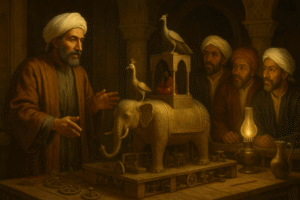
Early Life and Rise to Power
Li Si (李斯) was a pivotal statesman and political theorist during the late Warring States period and the early Qin dynasty. Born in the state of Chu, he studied under the renowned philosopher Xunzi, who championed rational order, law, and strong government as antidotes to chaos.
Ambitious and pragmatic, Li Si left Chu to seek his fortune in Qin, then an aggressively reforming state. Under King Zheng (later Qin Shi Huang), he rose rapidly, becoming Chief Minister and eventually Chancellor. He persuaded the king to pursue outright conquest of the rival states, helping unify China by 221 BCE.
 Legalist Philosophy and Centralisation
Li Si was a staunch Legalist. He believed:
-
Law over morality: The state should be governed by strict, impersonal laws rather than by virtue or moral example.
-
Strong central authority: Power must be concentrated in the hands of the ruler, with merit-based bureaucracy enforcing uniform policy.
-
Control of information: Dissent and rival schools of thought threatened unity, so intellectual diversity had to be tightly managed.
He helped dismantle the old feudal aristocracy, replacing it with centrally appointed officials. This centralisation allowed Qin to rule its vast new empire effectively—at least initially.
The Book Burnings and Scholar Executions
In 213 BCE, fearing dissent, Li Si advised Qin Shi Huang to burn non-Legalist texts and bury alive several hundred Confucian scholars who opposed imperial policy. These acts aimed to suppress alternative ideologies and consolidate imperial ideology, though they tarnished Qin’s legacy. While effective in the short term, this repression contributed to widespread resentment and later rebellion.
Downfall and Death
After Qin Shi Huang’s death in 210 BCE, Li Si became embroiled in a palace coup orchestrated by the eunuch Zhao Gao. Initially cooperating, he was later betrayed, accused of treason, and executed by the gruesome “five punishments” in 208 BCE—just two years before the Qin dynasty collapsed.
Conclusion
Li Si stands as one of the most consequential figures in Chinese history: a man who rose from obscurity to shape an empire. Trained in the rigorous rationalism of Xunzi’s Legalism, he helped transform Qin into a tightly controlled bureaucratic machine—strong enough to conquer the Warring States and unite China for the first time. Yet the same machinery he built became brittle, cracking under its own harshness. His life reveals how brilliant statecraft can veer into tyranny when fear eclipses flexibility, and how centralised power, while efficient, becomes fragile without the safety valve of dissent.
Why Li Si Still Matters
Li Si’s story offers a timeless caution about power and control. He showed how systems built on strict rules and central authority can achieve rapid success—but also how they risk collapse if they crush debate, creativity, and humanity.
Modern states and organisations still grapple with this balance: efficiency versus freedom, unity versus diversity. Li Si reminds us that while laws can bind a nation together, they cannot alone sustain it. Without trust, tolerance, and renewal, even the strongest empires can crumble overnight.
His legacy lingers as a double-edged lesson: order is vital, but must never come at the cost of the human spirit that makes order worth having.
Further Reading
- “Li Si” — Britannica
- “Legalism in Ancient China” — Stanford Encyclopedia of Philosophy
- Chinese Philosophy: Overview of History — Internet Encyclopedia of Philosophy
- Wikipedia: Li SI
See Also on Philosophical Chat
Image attribution: AI generated impression ChatGPT