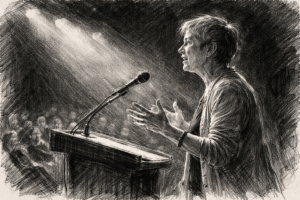
Huizi (also known as Hui Shi, 惠施) is one of the most intriguing and elusive figures in early Chinese philosophy. A contemporary of Zhuangzi and a leading light of the School of Names (Míngjiā), he was part of a circle of intellectuals fascinated by logic, language, and paradox — the kind of philosophical puzzles most other Chinese schools ignored.
He lived during the Warring States period, a time of political upheaval and fierce intellectual competition. While Confucians debated morality and Mohists debated ethics, Huizi and his fellow logicians delighted in tearing apart assumptions — showing that words and categories could twist reality into knots.
Huizi and Zhuangzi — Sparring Partners and Friends
Huizi’s fame owes as much to his friendship (and rivalry) with Zhuangzi as to his paradoxes themselves. The Zhuangzi text often portrays the two debating. Zhuangzi teases Huizi for being clever but missing life’s essence, while Huizi accuses Zhuangzi of being impractical.
A famous anecdote captures their relationship perfectly:
They stand on a bridge watching fish. Zhuangzi says, “See how happy the fish are.”
Huizi replies, “You are not a fish — how do you know they are happy?”
Zhuangzi fires back, “You are not me — how do you know I do not know?”
It’s witty, but it reveals something deeper: Huizi was a logical literalist, while Zhuangzi embraced intuitive relativism. Despite their verbal duels, they seemed to respect each other deeply.
The Ten Paradoxes of Huizi — Explained
The Zhuangzi preserves ten of Huizi’s paradoxical statements. At first glance, they look like jokes or nonsense. But each one probes deep questions about space, time, perspective, logic, and reality itself. Here they are, with modern interpretations:
1. “The largest thing has nothing beyond it; it is called the Great One. The smallest thing has nothing within it; it is called the Small One.”
Meaning: The biggest thing contains everything; the smallest has no parts.
Insight: This challenges our notions of scale. If something is infinitely large or infinitely small, our words like “big” and “small” break down. It foreshadows ideas about infinity and indivisible atoms.
2. “What has no thickness cannot be piled up, yet it is a thousand li in dimension.”
Meaning: Points have no size, yet make up lines.
Insight: This exposes the paradox of the continuum. Infinitely many zero-sized points can make something measurable — a puzzle that wouldn’t be solved until modern calculus.
3. “Heaven is as low as earth; mountains are level with marshes.”
Meaning: From far enough away, everything looks flat.
Insight: This reveals the relativity of perspective — high and low are not absolute qualities, only relational ones. Change your frame, and they disappear.
4. “I set off for Yue today and arrived there yesterday.”
Meaning: Time seems to reverse depending on how you look at it.
Insight: This challenges the linearity of time. Events’ order depends on perspective — a strangely modern anticipation of time-zone paradoxes and relativistic thinking.
5. “The centre of the world is north of Yan and south of Yue.”
Meaning: The world’s centre is beyond both extremes.
Insight: There is no fixed centre — every observer makes themselves the centre. It’s an early critique of parochialism and the illusion of absolute reference points.
6. “I know the centre of the world: it is north of Yan and south of Yue.”
Meaning: Claiming certainty about something meaningless.
Insight: This mocks false certainty — showing how people use confident language even where knowledge is impossible. It’s a sly attack on human arrogance about knowing.
7. “Let love embrace the ten thousand things; Heaven and Earth are one body.”
Meaning: All things are part of one whole.
Insight: This hints at a universalist ethic. If distinctions are artificial, then everything should be treated with care. It’s a rare glimpse of Huizi’s moral vision beneath the logic.
8. “The shadow of a flying bird has never moved.”
Meaning: Motion is an illusion created by perception.
Insight: At each instant, the shadow is still; only over time does it seem to move. This mirrors Zeno’s paradoxes and questions whether motion truly exists.
9. “Linked rings can be separated.”
Meaning: Conceptually, they are separate; physically, they are not.
Insight: This shows how language can separate what reality keeps joined. It warns against mistaking conceptual categories for physical truths.
10. “Eggs have hair.”
Meaning: They don’t now, but they will.
Insight: This exposes the gap between potential and actual. If an egg can become something hairy, then hair is present in potential. It foreshadows Aristotle’s concept of potentiality versus actuality.
Huizi’s Method — Logic as a Tool for Disruption
Unlike most of his contemporaries, who sought harmony, virtue, or practical guidance for rulers, Huizi used logic as a disruptive force. He treated language not as a vehicle for truth, but as a labyrinth to expose hidden assumptions. By twisting definitions, stretching categories, and colliding opposites, he revealed how easily words could undermine the very realities they claim to describe.
This was a radical approach in ancient China. While others sought clarity, Huizi sought instability — not to destroy meaning, but to show how fragile it really is. His paradoxes weren’t answers; they were mental stress-tests, designed to snap rigid thinking and spark new ways of seeing.
Why Huizi Still Matters Today
Huizi’s paradoxes were not idle tricks. They were thought experiments that undermined rigid categories and showed how much depends on perspective, scale, language, and time.
While Confucians saw him as dangerously clever and Zhuangzi saw him as brilliantly limited, Huizi pushed Chinese philosophy into new territory — toward abstraction, scepticism, and even proto-scientific thinking.
He showed that truth is not as solid as it seems — a lesson that still matters in an age flooded with competing claims of certainty.
Further Reading
- Stanford Encyclopedia of Philosophy: School of Names
- Wikipedia – Huizi
- The Zhuangzi, Chapters 17 and 33 (for anecdotes about Huizi)
- A.C. Graham, Disputers of the Tao (classic academic overview of the period)
See Also on Philosophical Chat: