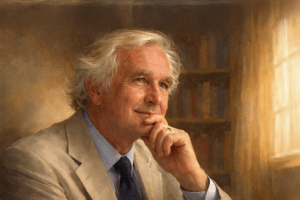
Dewi Zephaniah Phillips, often cited as D.Z. Phillips, belongs to that rare group of philosophers who saw religion not as a puzzle to solve, but as a world to understand. Born in Swansea in 1934, Phillips developed a body of work that challenged the habit of treating religious belief as a kind of failed science, an outdated hypothesis, or a primitive answer to modern questions.
His approach is not easily categorised. He is not preaching, but he is not dismantling faith either. Instead, Phillips encourages a shift in attention: away from abstract claims about the supernatural, and towards the practical and emotional landscapes of real human lives.
What emerges is a philosophy that makes space for sincerity without demanding certainty.
Religion as a Form of Life
At the centre of Phillips’ thought is a simple but radical idea:
religion should not be understood as a theory.
He draws on the legacy of Ludwig Wittgenstein to argue that religious practices, prayers, rituals, and ethical commitments are woven into ways of living — not attempts to describe invisible mechanisms. Asking whether God “exists” as if the concept is a laboratory object misses the point, like asking whether grief “exists” in the same way as gravity. Both are real, but in different registers.
For Phillips, religious language expresses:
- longing
- moral aspiration
- the attempt to find meaning in suffering
- the shaping of communities
- emotional orientation to the world
To treat those expressions as crude hypotheses is to misunderstand them.
This stance protects religious belief from bad-faith attacks, but it also protects it from overconfident defenders — those who insist faith must compete with empirical knowledge. Phillips refuses both extremes. In his view, faith does not need to win that fight because it was never in that ring to begin with.
A Critic of Apologetics and Aggressive Atheism
Phillips’ position sometimes made him uncomfortable company for both sides of the debate.
He challenged:
- religious apologists who treat scripture like evidence
- atheists who treat theology like pseudoscience
In both cases, he believed something essential gets lost: the actual lived experience of believers.
Phillips is not saying everyone should believe. He is saying we should listen before we judge — understand what religious commitment means before deciding what it is worth. This is philosophy as patience instead of conquest.
Suffering, Hope, and the Limits of Explanation
A powerful thread in Phillips’ writing is the problem of suffering. If religion is not a factual hypothesis, then the problem of evil — “Why would God allow suffering?” — looks different. Phillips is not interested in logical gymnastics that justify pain. He rejects what he sees as the cruelty of theological explanations that claim suffering is a test, punishment, or lesson.
Instead, he insists that suffering resists explanation. Religion should not try to tidy it away.
Faith, at its best, offers:
- companionship
- shared endurance
- rituals of mourning
- a language for despair
- a refusal to face suffering alone
This is where Phillips is at his most profound. He argues that religion can be meaningful without being explanatory. It can respond without solving. It can heal without answering.
Where Phillips Fits in Modern Philosophy
In an age of online debate, where religion is often reduced to a spectator sport (“prove it” vs “you’ll see when you’re dead”), Phillips feels almost shockingly mature. His work sits quietly in the background, reminding us that human life is not always best understood through confrontation.
In this sense, he offers a counterbalance to both the new atheists (e.g. Richard Dawkins) and to modern apologetics. If Dawkins demands evidence for God’s existence, Phillips replies that the demand reveals a misunderstanding. If apologists respond with clever arguments, Phillips asks whether those arguments illuminate belief or simply defend a position.
His legacy is not prescriptive; it is diagnostic. He shows us where the conversation goes wrong, and gestures towards a different way of speaking.
Conclusion
D.Z. Phillips gives us permission to approach religion without armour. He invites us to suspend the need for victory and instead practice attention. Philosophy, for him, is not an arena; it is a listening room. Religious belief is not a claim to be proven, but a human activity to be understood — a way of living one’s vulnerability, hope, grief, and gratitude.
Whether you are a believer, a sceptic, or simply curious, Phillips’ work offers a way to explore religion without dismissing or defending it. In a culture addicted to certainty, his writing feels like a quietly radical act.
Further Information