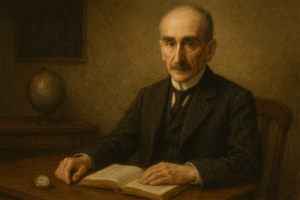
Wang Yangming (王阳明), born Wang Shouren, was a Ming dynasty philosopher, statesman, and military leader who reshaped Confucian thought with ideas that continue to influence East Asian philosophy today. He is best remembered for uniting knowledge and action and for teaching that moral truth lies within each individual. In many ways, Wang Yangming offered a radical answer to the intellectual challenges of his age.
 Life and Background
Born in 1472 in Yuyao, Zhejiang province, Wang came of age in the Confucian education system that dominated imperial China. He passed the civil service examinations and served in a range of government posts. His career was turbulent: he was banished for offending a powerful eunuch, endured exile, but later rose to prominence as a successful general who put down revolts in southern China.
These experiences shaped his philosophy. Unlike many armchair scholars, Wang tested his ideas in both civil administration and the battlefield. His personal struggles convinced him that morality was not just a matter of abstract study, but something to be lived in every moment.
Key Ideas
1. The Unity of Knowledge and Action (知行合一, zhī xíng hé yī)
For Wang Yangming, knowledge and action were not two separate stages but one unified process. He believed that to truly “know” something is to live it. If a person claims to know filial piety but neglects their parents, then in reality, they do not truly understand filial piety.
-
Why it mattered: This was a direct challenge to the intellectualism of his time, where scholars spent decades in textual study while avoiding the messiness of real life. Wang argued that moral knowledge that doesn’t transform behavior is hollow.
-
Modern resonance: In today’s terms, it’s the difference between reading a thousand books on kindness and actually being kind to the stranger on the street.
2. Innate Knowledge of the Good (良知, liángzhī)
Perhaps Wang’s most famous concept, liangzhi refers to the idea that all humans are born with an innate capacity to know right from wrong. This moral compass is not learned from books but arises naturally from the heart-mind (心, xīn).
-
Practical implications: For Wang, education was not about cramming knowledge but about removing selfish desires that cloud this inner light. Once these obstructions are cleared, a person acts with natural clarity and benevolence.
-
Influences: This idea has parallels with Mencius, who argued for the innate goodness of human beings. But Wang sharpened the point: it’s not just that we have a tendency toward goodness, but that we already know the good—we just need to act on it.
3. Sincerity and Introspection
Wang emphasized sincerity (诚, chéng) as the foundation of self-cultivation. Instead of endless external investigation, he urged students to turn inward, examine their intentions, and correct them. Every situation in life—whether serving in office, facing family difficulties, or even leading troops—was an opportunity to refine one’s heart-mind.
-
Why it mattered: By moving the focus inward, Wang brought philosophy out of the academy and into the marketplace, the home, and the battlefield. Morality was not for special times and places, but for every action of life.
4. Critique of Bookish Learning
Wang became increasingly critical of the intellectual trends that dominated Neo-Confucianism in his day. Scholars, he thought, often hid behind textual debates while neglecting their moral responsibilities. For Wang, genuine learning could not be separated from lived virtue.
-
Example: He once said that someone could spend their life studying the word “filial piety” without ever truly understanding it—while a peasant woman who cares for her elderly parents embodies the principle more perfectly than any scholar.
-
Impact: This critique gave his philosophy a populist edge. Ordinary people, not just elite scholars, could embody true Confucian virtue.
5. The Heart-Mind as Principle (心即理, xīn jí lǐ)
Where Zhu Xi located li (principle) in the structure of the external world, Wang argued that principle resides within the heart-mind itself. To grasp universal truth, one should not endlessly investigate things outside but cultivate the clarity of one’s own mind.
-
Why it mattered: This was a philosophical revolution. It inverted centuries of emphasis on external study and placed ultimate authority within the individual’s conscience.
-
Consequences: Critics feared this would make morality too subjective. Admirers saw it as empowering, a philosophy of personal responsibility and freedom.
Wang Yangming vs. Zhu Xi
Wang Yangming is often contrasted with Zhu Xi (1130–1200), the great Neo-Confucian thinker of the Song dynasty. Zhu emphasized the investigation of things (格物, gewu) as the path to understanding principle (理, li). Wang flipped this approach: rather than searching for truth in the outside world, he taught that the moral compass already lies within.
This shift made Wang’s philosophy more inward, intuitive, and—some would say—radical. It also aligned him closer to Buddhist and Daoist traditions, which emphasized introspection and enlightenment from within.
Influence and Legacy
Influence in China
Within Ming China, Wang’s ideas sparked what became known as the School of Mind (心学, xīnxué), which rivaled Zhu Xi’s School of Principle. His followers carried his teachings into education, politics, and everyday moral practice. For many, his message of inward reflection was liberating—it meant one didn’t need to be a scholar-official or spend decades in textual analysis to access moral truth.
Influence in Japan
Wang Yangming’s philosophy had a profound effect on Japan, particularly during the Tokugawa period (1603–1868). His emphasis on decisive moral action resonated with the samurai class. Known in Japanese as Ōyōmei-gaku, his ideas were absorbed into the bushidō code and shaped the moral outlook of warrior culture. The unity of knowledge and action was especially appealing to those whose lives demanded swift and ethically charged decisions.
Influence in Korea
In Korea, Wang’s ideas stirred controversy among Neo-Confucian scholars. Some embraced his emphasis on the inner moral compass, while others worried it encouraged subjectivity and threatened social order. Nonetheless, his thought contributed to the rich debates within Joseon-era Confucianism and shaped the reformist currents that later emerged.
Resonance with Buddhism and Daoism
Wang’s stress on introspection and uncovering innate truth paralleled Chan (Zen) Buddhism, which emphasized enlightenment from within, and Daoist ideas of natural spontaneity. This blending of Confucian rigor with Buddhist and Daoist inwardness gave his teachings a universal appeal that transcended orthodox boundaries.
Modern Relevance
Wang Yangming’s philosophy continues to find new life in modern contexts:
-
Education: His idea that morality is already within the student resonates with child-centered teaching approaches.
-
Psychology: His notion of clearing selfish desires to reveal innate knowledge has echoes in modern psychology’s concern with authenticity and self-actualization.
-
Leadership and Business: In East Asian management theory, Wang’s unity of knowledge and action is cited as a model for decisive, values-driven leadership.
Enduring Message
Wang’s enduring legacy lies in his empowerment of the individual. Instead of relying solely on external authority or endless intellectual exercises, he affirmed that each of us already has the seeds of moral knowledge. The challenge is to act with sincerity, courage, and consistency.
Why Wang Yangming Still Matters
In an age of information overload, Wang Yangming’s call to unite knowledge and action feels particularly relevant. We “know” more than ever before, but wisdom is proven not in what we read or recite, but in what we do. His reminder that moral truth is already within us—waiting to be acted upon—remains as fresh and challenging today as it was in Ming China.
Further Reading
-
Chan, Wing-tsit. Instructions for Practical Living and Other Neo-Confucian Writings by Wang Yang-ming. Columbia University Press, 1963.
– A classic English translation of Wang’s works with helpful commentary. -
Ivanhoe, Philip J. Ethics in the Confucian Tradition: The Thought of Mengzi and Wang Yangming. Hackett, 2002.
– Explores Wang in dialogue with Mencius, highlighting their shared belief in innate moral knowledge. -
de Bary, Wm. Theodore. Sources of Chinese Tradition, Vol. 1. Columbia University Press, 1999.
– Includes excerpts from Wang’s writings alongside other major Chinese thinkers. -
Tucker, John Allen. Itō Jinsai’s Gōmō jigi and the Philosophical Definition of Early Modern Japan. Brill, 2006.
– Shows how Wang Yangming’s ideas influenced Japanese thought, especially among the samurai. -
Angle, Stephen C. Contemporary Confucian Political Philosophy: Toward Progressive Confucianism. Polity, 2012.
– Discusses how thinkers like Wang Yangming inspire modern approaches to Confucian ethics and politics.
Online resources
-
Stanford Encyclopedia of Philosophy – Wang Yangming
-
Internet Encyclopedia of Philosophy – Wang Yangming
- Wikipedia – Wang Yangming
See Also on Philosophical Chat
Image attribution:
Shen Junhui (沈俊繪), Public domain, via Wikimedia Commons