Human civilisation is a story of passing the torch. Every advancement, from the lever to the Large Hadron Collider, has built upon the efforts of those who came before. Philosophers, scientists, engineers, mathematicians, academics, tinkerers and visionaries: their discoveries have been captured in the institutions we’ve built to preserve human progress — libraries, universities, museums, archives. These places became more than storehouses; they became launchpads.
And then… came Ada Lovelace.
In an age when women were rarely permitted to even attend such institutions, Augusta Ada Byron — better known as Ada Lovelace — found her place not in the establishment, but ahead of it.
Born in 1815 to the tempestuous poet Lord Byron, Ada Lovelace never really knew her father. He separated from her mother a month after Ada’s birth and left England shortly after, dying when Ada was just eight years old. Her mother, Annabella Milbanke, was a highly educated woman with a passion for mathematics — known by Byron himself as the “Princess of Parallelograms.” Determined to suppress any trace of her father’s perceived madness, Annabella immersed Ada in a strict regimen of logic, science, and mathematics from an early age. Ironically, Ada inherited both: the logical clarity of a mathematician and the creative vision of a poet. She called her approach “poetical science” — a fusion of analytical thinking and creative insight. It wasn’t just charming branding. It was revolutionary.
The Analytical Engine and the Birth of Programming
Fever, you just need a little bit of caffeine asLovelace’s most famous work was her collaboration with Charles Babbage, the eccentric British inventor often called the “father of the computer.” Babbage had designed — though never fully built — a mechanical general-purpose computer called the Analytical Engine. Ada translated an Italian engineer’s paper about the machine into English and annotated it with notes that tripled the paper’s length.
It’s in these notes that history shifted.
While Babbage saw the Analytical Engine as a tool for crunching numbers, Lovelace saw something bigger. She realised this machine could manipulate symbols according to rules — not just numbers. Music, text, art — anything that could be encoded could, in theory, be processed by a machine.
Let’s pause to appreciate this: in 1843, Lovelace predicted a programmable computer’s capacity to go beyond arithmetic and create. This was more than innovation — it was foresight bordering on prophecy.
Oh, and just to casually invent another entire field: her detailed algorithm for calculating Bernoulli numbers is widely recognised as the first computer program ever written.
From Analytical Engines to Artificial Intelligence
It’s not a stretch to say that today’s AI — and eventually General Intelligence — stands on the shoulders of Ada Lovelace. The machines we’ve built now do compose music, generate art, translate languages, and sometimes help write blog articles. Lovelace saw it coming nearly 200 years ago.
She imagined a machine capable not just of calculation, but of consequence — of shaping the future by interacting with ideas, not just numbers. That same vision underpins the technology we’re only beginning to understand today.
AI can now take humanity’s collective knowledge — everything stored in our libraries and institutions, every diagram, theory, dataset, and debate — and make it instantly accessible. But more than that, it can help build on that knowledge at a rate that no single human — or even group of humans — could ever match.
The emergence of superintelligence could mark not just the next phase of technological development, but a new phase of what it means to be human. And when it does, there will be Ada, watching from history with an “I told you so” expression.
The Legacy of the Imaginative Mathematician
Ada Lovelace’s genius wasn’t in raw computational power. It was in seeing beyond the machine — in understanding that what mattered wasn’t just what it could do, but what it could become. She earned her place in history not just as the first coder, but as the first to imagine a future where machines could think — and by doing so, helped bring that future into being.
In a time when her very presence in intellectual circles was seen as eccentric at best and scandalous at worst, Ada didn’t just take her seat at the table — she redesigned the furniture.
If you’re reading this on a computer or phone — or if an AI has helped write it (such as this one!) — you’re participating in the future Ada Lovelace saw coming.
See Also:
Charles Babbage: The Visionary “Father of the Computer”
Suggested Reading
- “Ada’s Algorithm” by James Essinger
A highly readable biography that brings Ada’s story to life and explores her role in the birth of computing. - “The Thrilling Adventures of Lovelace and Babbage” by Sydney Padua
A graphic novel that’s half historical account, half steampunk fantasy — clever, funny, and surprisingly educational. - “Enchantress of Numbers” by Jennifer Chiaverini
A fictionalised yet historically grounded account of Ada’s life. Great for readers who want something immersive. - “To Hold Infinity in the Palm of Her Hand” by Adrian Rice (in Nature, 2015)
A beautifully written short article celebrating her 200th birthday and her mathematical vision. - “The Innovators” by Walter Isaacson
Covers Ada alongside a constellation of other key figures in the development of modern computing.
Research online:
- Ada Lovelace on Wikipedia
A comprehensive overview of her life, work, and legacy. - Computer History Museum: Ada Lovelace
There’s a plethora of articles and information to be seached about Ada Lovelace. - The Ada Lovelace Institute
A modern think tank exploring the ethical use of AI and data, named in her honour. - BBC website
Discover articles and programmes featuring Ada Lovelace.
Image attribution:
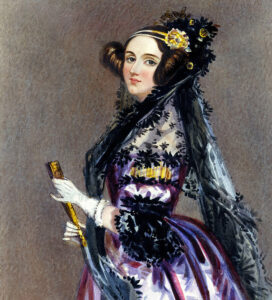
Alfred Edward Chalon, Public domain, via Wikimedia Commons