

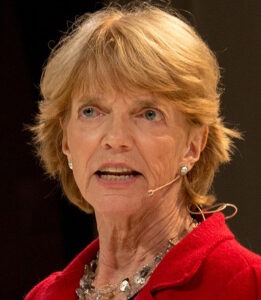
Patricia Churchland (born 1943) is a philosopher best known for reshaping how philosophy approaches the mind. A founding figure of neurophilosophy, she argues that questions about consciousness, morality, and the self cannot be answered without taking neuroscience seriously. If earlier philosophy tried to understand the mind by introspection alone, Churchland insists we must look at the brain itself.
Her work challenges long-standing assumptions about free will, the soul, and moral reasoning, replacing them with an empirically grounded view of human nature. For Churchland, philosophy and science are not rivals; philosophy progresses by learning from the best available science.
 Core Ideas
1. Neurophilosophy
Churchland’s central claim is that many traditional philosophical problems about the mind are poorly framed because they ignore neuroscience. Concepts like “belief,” “desire,” or even “consciousness” may not map neatly onto how the brain actually works.
Rather than forcing neuroscience to fit old philosophical categories, she argues that philosophy should adapt as scientific understanding improves.
2. Eliminative Materialism
One of Churchland’s most controversial positions is eliminative materialism: the idea that some everyday psychological concepts (often called “folk psychology”) may eventually be replaced, not refined, by neuroscientific explanations.
Just as ancient theories about spirits and humours were discarded, Churchland suggests that future neuroscience may radically revise how we talk about minds.
3. Morality Without Metaphysics
In her later work, Churchland turns to ethics, arguing that moral behaviour is rooted in biology, especially social bonding, empathy, and brain chemistry. Moral norms, she suggests, grow out of evolved capacities for cooperation rather than divine command or abstract rational laws.
This does not cheapen morality; it explains how moral concern arises naturally in social animals like us.
4. The Brain as a Learning System
Churchland emphasises that the brain is a highly adaptive, learning system shaped by evolution and experience. Understanding neural plasticity helps explain habits, addiction, moral development, and even political disagreement.
Why She Matters
Patricia Churchland is important because she forces philosophy to grow up alongside science. She dismantles the idea that philosophy can remain insulated from empirical discovery and shows how neuroscience can illuminate some of our deepest questions about who we are.
For students encountering philosophy of mind, she is often a turning point: unsettling, provocative, and impossible to ignore.
Key Works
- Neurophilosophy (1986)
- Brain-Wise (2002)
- Braintrust: What Neuroscience Tells Us about Morality (2011)
- Touching a Nerve (2013)
Further information
- Wikipedia – Patricia Churchland
Image Attribution:
Vera de Kok, CC BY-SA 4.0, via Wikimedia Commons




.jpg)