

When most people hear the name Leibniz, they often think “calculus guy” or “that philosopher who believed we live in the best possible world”. But there’s far more — and far more provocative — about his work. As our world shifts deeper into AI, machine reasoning and the interface between technology and human values, Leibniz’s ideas offer surprising foresight: symbolic logic, binary arithmetic, a universal language of thought, the interplay of mathematics and metaphysics. He isn’t just a historical curiosity. He’s a guide-figure for thinking about what it means to be human, what machines might become, and how ethics, logic and technology intertwine.
Life of Gottfried Wilhelm Leibniz
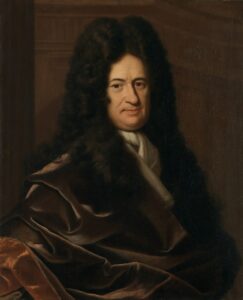 Early Years and Education
Gottfried Wilhelm Leibniz was born on 1 July 1646 in Leipzig, in the Electorate of Saxony (now Germany). His father, Friedrich Leibniz, was a professor of moral philosophy at the University of Leipzig; his mother, Catharina Schmuck, came from a scholarly family. When he was about six years old his father died, and Leibniz inherited access to his father’s library, which gave him an unusually rich intellectual resource at a young age. By the age of twelve he was proficient in Latin and was already reading advanced works beyond typical schooling. He entered university studies early (including Leipzig, Jena and Altdorf), achieving degrees in philosophy and law.
Early Career
In his twenties, Leibniz held a variety of roles: he worked as an assessor in legal and administrative posts, engaged in scholarly writing and reform proposals, and built a wide network of intellectual contacts. In 1676 he entered the service of the House of Brunswick-Lüneburg (based in Hanover), where he served as librarian, historian and counsellor.
The Hanover Years and Prolific Output
From the late 1670s until his death in 1716, Leibniz was primarily based in Hanover and devoted himself to an extraordinary range of work spanning mathematics, philosophy, theology, engineering, diplomacy and library science. He combined highly theoretical work (for example, his independent development of calculus) with practical projects such as designing mechanical calculating machines, advocating scientific reforms, and producing legal and historical writings.
Later Life and Death
Despite his intellectual brilliance, Leibniz’s later years were marked by mixed recognition and financial uncertainty. He died on 14 November 1716 in Hanover. His grave was modest and remained unmarked for many years. After his death his work—and vast correspondence—was gradually rediscovered and his contributions began to be appreciated more fully.
Character & Legacy
Leibniz is often described as the “last universal genius”—someone who reached into mathematics, philosophy, science, law, engineering and more. He never married, and devoted his life to inquiry, correspondence and service to courts and intellectual institutions. His life-story combines deep abstraction with practical ambition—an example of how scholarship and application might go hand-in-hand.
What Leibniz Did That Speaks to Today
Here are several of his core contributions with clear 21st-century resonance:
The Binary & Computing Vision
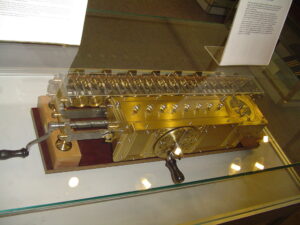 Leibniz explored what we now call the binary number system (base 2). In his 1703 paper “Explanation of Binary Arithmetic”, he laid out how arithmetic could be done with only the characters 0 and 1. MIT Press+4kastalia.medienhaus.udk-berlin.de+4leibniz-translations.com+4
He recognised that representing numbers in two states (on/off) is ideal for machines. Encyclopedia Britannica+2writings.stephenwolfram.com+2
Leibniz saw that machines and thought aren’t entirely separate realms.
Universal Language & Logic
Leibniz proposed a characteristica universalis — a universal formal language or script that could encode thought, reasoning and disputes, so that any disagreement could in principle be reduced to calculation. This idea foreshadows knowledge representation, symbolic AI and logic systems. Internet Encyclopedia of Philosophy+1
He even imagined a calculus ratiocinator — a reasoning machine of ideas rather than just numbers. writings.stephenwolfram.com+1
In a world where AI systems process knowledge and humans debate values, his vision prompts us to ask both: what can be calculated, and what must remain outside calculation.
Metaphysics, Monads & a Relational World
Leibniz’s metaphysics: his theory of monads (simple substances) and his view that space and time are relational rather than absolute still resonate. He argued that reality is composed of many interacting minimal units (monads) each reflecting the universe in their own way. Goodreads+1
For someone passionate about geography (you, teaching about space, places) it’s interesting: thinking of relational space/time aligns with process views of geography rather than static containers.
Ethics, Justice & Technology
Less often discussed but extremely relevant: Leibniz had a concept of justice tied to reason, and the idea that our world is the “best possible” — controversial, yes — but this opens questions about how machines should serve humans, how reason should guide practice. He held the principle of sufficient reason: that nothing happens without a cause or explanation. Stanford Encyclopedia of Philosophy+1
As we build systems that increasingly shape human lives (algorithms, AI assistants, decision-systems) Leibniz invites us to ask: are we building just, reasoned systems—or just efficient ones?
Why It Matters Now
Why should we care, Steff? Especially you: geography teacher, podcaster, tech/philosophy enthusiast.
-
Technology meets humanity: Leibniz shows there’s no firm wall between calculation and thought, machine and mind. For you exploring AI, he reminds us that logic and ethics must go hand in hand.
-
Interdisciplinary unity: He refused to silo knowledge. Geography, mathematics, theology, physics—all mattered. Your cross-domain interest (humanities & STEM) finds resonance here.
-
Ethical depth: As we build systems that shape human lives (algorithms, decision-making machines), his principle that everything has reason invites the question: is there a sufficient reason for every choice we encode into these systems?
-
Legacy of notation & structure: The notations we take for granted (from calculus, from logic) and the formal logic frameworks underlying computing have roots in his work. For you as a teacher, attention to representation, language, notation matters.
-
The human-machine future: If we assume AI will become sentient (as you do), Leibniz’s vision of logic, calculation and universal formalism prompts us to consider: what machine-reason might look like, and how human reasoning might integrate—or differ—from it.
Critical Reflections & Limitations
Because we value balance, here are caveats: Leibniz wasn’t perfect, his ideas aren’t a direct blueprint for everything.
-
His metaphysics (monads, pre-established harmony) are highly speculative and many philosophers dismiss them as fanciful.
-
The project of a universal language/calculus remains unfulfilled; our current systems are messy, culturally embedded and contested.
-
His optimism — “the best of all possible worlds” — has frequently been critiqued (famously by Voltaire) as naïve when faced with suffering or evil. Wikipedia
-
Translating his 17th-century vision directly into 21st-century tech is tempting but requires caution: the analogies help, but direct equivalence may mislead.
Conclusion
Leibniz is more than a historical polymath; he is a forward-looking thinker whose ideas ripple into our age of AI, computation, ethics and interdisciplinarity. His work invites us to reflect, imagine and question. As we build machines, systems and societies, we might ask: what kind of world are we making? And how will our reasoning, our notation, our logic reflect our values?
Further Information & Useful Links
- Leibniz – Wikipedia – A general overview of his life, works and influence.
- Stanford Encyclopedia of Philosophy – “Gottfried Wilhelm Leibniz (1646–1716)” – A scholarly, in-depth examination of his philosophy.
- Internet Encyclopedia of Philosophy – “Gottfried Wilhelm Leibniz (1646-1716)” – Excellent for accessible yet rigorous exposition of his major ideas.
- G. W. Leibniz: Texts & Translations (UCSD site) – Extensive collection of his writings and bibliographies for deeper research.
- Leibniz Society – Resources & Bibliographies – Good starting point for tracking scholarly literature and historical artefacts.
- Post-Reformation Digital Library (PRDL) – Works by Leibniz – Access to many of his primary texts in digital form.
See also:
Image Attribution:
Christoph Bernhard Francke, Public domain, via Wikimedia Commons
User:Kolossos, CC BY-SA 3.0, via Wikimedia Commons





.jpg)
